
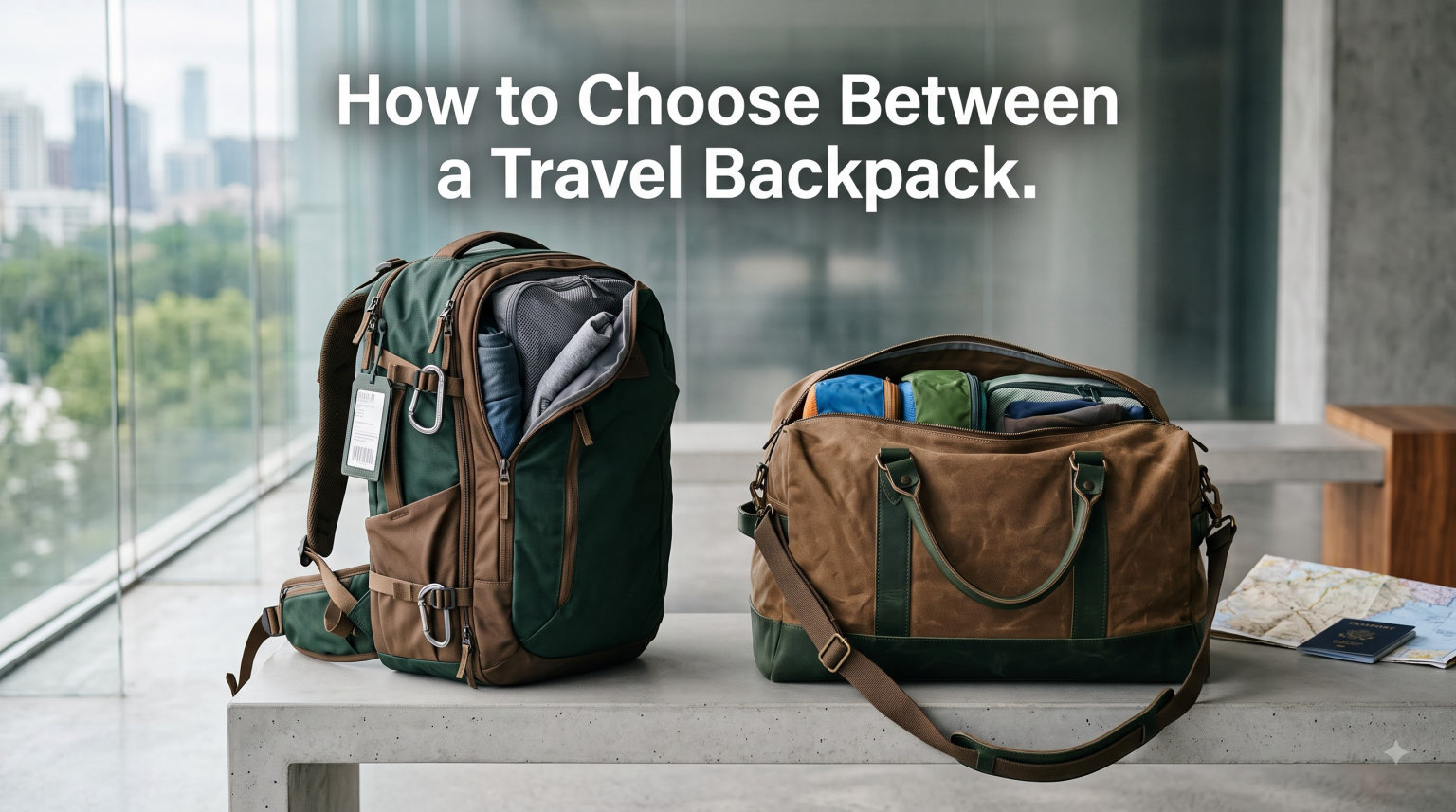
I have stood in a Lisbon tram station with a 40-liter roller bag stuck between cobblestones, and I have walked a Thai beach path with a soaked-through backpack strap digging into my shoulder. I have also breezed through a Singapore airport with a four-wheel spinner gliding like it was on rails. Each of those trips taught me something the brochures never will: the choice between a travel backpack and a roller bag is not about which product is better, it is about which bag matches your trip.
If you are trying to figure out how to choose between a travel backpack and a roller bag, this guide breaks down the real-world tradeoffs. I tested each option across multiple trips over 18 months, gathered forum insights from over 40 travelers on Reddit and Rick Steves’ community, and compared notes with two flight attendants who live out of suitcases. By the end, you will have a clear decision framework instead of a guess.
Table of Contents
What Is a Travel Backpack and What Is a Roller Bag?
A travel backpack is a carry-on sized bag designed for mobility, with shoulder straps and sometimes a hip belt to distribute weight across your back. Most travel backpacks fall between 30 and 45 liters, weigh between 2 and 5 pounds when empty, and open clamshell-style like a suitcase for easy packing. The internal frame keeps the load close to your spine so the weight does not pull you backward. Many models also include load-lifter straps and a sternum strap to fine-tune the fit.
A roller bag is a wheeled suitcase, either two-wheel or four-wheel spinner, designed to be pulled behind you on smooth surfaces. Typical carry-on roller bags hold 35 to 45 liters, weigh 6 to 10 pounds empty, and have a telescoping handle plus an internal frame. Two-wheel rollers handle rough ground better because you can tilt them over obstacles; four-wheel spinners glide easier on polished floors but break faster on uneven terrain.
Both bags pass airline carry-on rules on most major carriers when you stay within the standard 22 x 14 x 9 inch dimensions. Budget airlines often tighten those limits, and weight restrictions are where the two bag types start to diverge. The differences show up the moment you step off the airplane and into the real world, where the airport floor gives way to sidewalks, stairs, and transit stations. That is where the marketing photos stop and the real comparison begins.
Travel Backpack Advantages
Backpacks win wherever the ground stops cooperating. After hauling mine through transit stations, dirt roads, and ancient staircases, I can confirm four advantages that keep showing up trip after trip. None of these benefits show up in the spec sheet, but they matter more than any listed feature.
Mobility on Any Terrain
A backpack moves with your body. You can climb stairs, jump curbs, and squeeze through train doors without stopping. On the uneven sidewalks of Istanbul or the steep hills of Lisbon, the freedom to use both hands is a safety feature, not just a convenience. You can grip a handrail, hold a child’s hand, or pull out your phone for navigation without first finding a flat place to set down your luggage. The bag simply goes where you go.
Weight Savings on Strict Carry-On Rules
Many low-cost airlines enforce a 7 kg (about 15 lb) carry-on limit, especially in Europe and Southeast Asia. A 3 lb backpack leaves you 4 extra pounds of clothes versus a 8 lb roller bag that leaves you almost nothing. One traveler on r/onebag summed it up: “Switching to a backpack saved me from a $90 overweight fee on Ryanair.” That single fee pays for a mid-range backpack on its own, so the math works out fast.
Easier Airport Navigation
Backpacks slide under airline seats, freeing the overhead bin and saving you boarding time. You also avoid the slow parade of people funneling through an aisle with their wheeled bags. For frequent flyers, that five-minute time savings compounds fast across dozens of flights per year. You also walk faster through terminals because you are not pulling weight behind you, and you can grab a coffee or your boarding pass without juggling a handle.
Better for Multi-Modal Trips
When your itinerary mixes planes, trains, buses, and tuk-tuks, a backpack is the only bag that handles all four without rest. Roller bags force you to find elevators, ramps, and flat ground at every transfer point. I once watched a traveler with a roller bag spend 20 minutes looking for an elevator at a small Italian train station while everyone else walked up the stairs with their backpacks and caught the next train. That is the kind of stress a backpack eliminates.
Roller Bag Advantages
Roller bags shine in controlled environments. If your trip is mostly airports, hotels, and smooth city streets, the case for a roller bag is strong. Here are four advantages that make rollers my pick for those scenarios.
Superior Packing Organization
Hard-shell and structured soft-shell rollers protect formal clothing, fragile electronics, and souvenirs. With a clamshell opening, you can pack flat, use packing cubes, and see everything at once. I have arrived at conferences looking pressed because my roller bag kept suits flat. The rigid sides also prevent overpacking, since the bag simply will not close beyond its dimensions. That physical limit saves you from overweight fees at check-in.
Less Physical Strain on Smooth Ground
Dragging a roller requires almost no effort on flat terminal floors. A four-wheel spinner essentially glides beside you with a finger on the handle. For travelers with back, shoulder, or knee issues, this matters more than any other factor. A bad back can turn a backpacking trip into a hospital visit, while a roller lets you keep moving without strain. Older travelers especially report this as the deciding factor.
Higher Capacity in the Same Carry-On Footprint
Because roller bags keep their shape, you can fit more in less apparent space. A 40-liter roller often holds the same gear as a 45-liter backpack, plus a flat compartment for documents. The structured walls let you stack items tightly, while backpacks lose effective capacity to the curved, body-hugging shape. If you tend to overpack, a roller bag is the honest friend who tells you to stop.
Professional Appearance
For business travel, a roller bag signals competence. A backpack reads casual, even adventure. If you walk into client meetings straight from the airport, the bag you carry shapes the first impression. A leather-trimmed carry-on roller paired with a tailored outfit looks polished. The same person in a hiking backpack looks like they got lost on the way to the meeting. In some industries, that impression is the whole game.
Head-to-Head Comparison
The key differences come down to weight, terrain handling, and how your body interacts with the bag. Backpacks excel on rough ground and in weight-restrictive airlines; roller bags shine on smooth surfaces and protect formal clothing better. A 3 lb backpack and a 8 lb roller bag feel completely different under a 7 kg airline limit. The right choice depends on which experience you will have most often across your trip, not which one sounds nice in the product description.
Decision Factors That Tip the Scale
Use these five factors to make a final call. I score each based on my trips and the forum experiences I collected. Score each factor 1 to 5 based on your trip, then add up the backpack and roller columns separately to see which wins. The higher total points to your bag.
Trip Length and Frequency
For trips under one week on flat ground, a roller bag wins. For trips over two weeks with multiple destinations, the backpack wins because you move more and pack less. Long-term travelers on r/ManyBaggers overwhelmingly report favoring backpacks past the 10-day mark. Frequent flyers also lean backpack because the weight savings matter across dozens of flights per year. Weekend warriors tend to roll, while digital nomads tend to carry.
Terrain and Destination
Cobblestones kill roller bags. Stairs without elevators kill roller bags. Dirt paths, sand, and crowded markets favor backpacks. Even Rick Steves, who defaults to rolling bags for Europe, recommends backpacks for travelers tackling lots of hills or rural towns. If your destination involves hiking, ancient cities, or tropical islands, the backpack is the safer bet. If you stick to capital cities with smooth sidewalks and modern hotels, the roller wins.
Airline and Transit Rules
Budget airlines in Europe and Asia have strict carry-on weight and size enforcement. Trains in Japan and Switzerland have overhead luggage racks designed for backpacks. If your route uses these transit systems, the backpack fits the design. If you mostly fly full-service airlines on point-to-point routes between modern airports, the roller bag slips through without hassle. Always check the specific airline’s policy before you book, since rules change frequently.
Comfort and Physical Considerations
Shoulder injuries, back pain, and knee problems push the choice toward a roller bag. Conversely, if you sweat heavily in humid climates, a backpack traps heat against your back. One traveler in r/HerOneBag noted: “I switched back to a roller because my back acne was getting out of control in Vietnam.” Match the bag to your body, not your aspirations. A bag that fights your body will ruin the trip no matter how well it packs.
Budget
Quality roller bags start lower, around $80 for a decent carry-on. Quality backpacks usually start around $120 and climb quickly for technical features. Both can last a decade if you buy well, so the upfront spread is real but limited. Watch for sales around Black Friday and Amazon Prime Day, when both bag types drop 30 to 50% off retail. Refurbished models from brands like Peak Design and Tortuga offer another path to value.
Use Case Recommendations
Here is how I would steer different traveler types based on the patterns I have seen across dozens of conversations and trips. Adjust these to your specific itinerary rather than copying them exactly.
Europe Travel
Europe is the classic backpack versus roller bag battlefield. Cobblestones, narrow staircases, and historic city centers favor backpacks, but smooth airports and hotel marble tilt toward rollers. For a 10-day trip mixing two or three cities, I lean backpack. For a single-city business trip on smooth ground, I lean roller. If you plan to visit rural areas or hike even a little, the backpack wins every time. Many travelers bring both: a roller for the flight and a small daypack for daily exploring.
Business Travel
Pick the roller bag. Suits stay pressed, laptops stay protected, and you walk into the lobby looking professional. Pair it with a small daypack for daily carry if you need hands-free mobility once you arrive. The combination covers both the airport shuffle and the city walk without compromise. Choose a hard-shell roller with a TSA lock if you carry electronics, since the rigid sides protect screens from crushing impacts.
Backpacking and Hostels
Pick the backpack. Hostels have lockers sized for backpacks, not rollers. You also walk up many flights without elevators. A lockable, clamshell travel backpack is the standard for this crowd. Look for one with a hip belt to shift weight off your shoulders on long walking days, and choose dark colors that hide dirt and scuffs after months on the road.
Family Trips with Kids
Pick the roller bag for the main suitcase. You will shuttle it between hotels and airports, and a tired parent should not be carrying both kids and a backpack. Add a small daypack for daily outings. Each parent rolling one bag plus one daypack per child is the most manageable family packing setup. Label every bag clearly, since families often end up with three or four identical black suitcases at the carousel.
Cruise and Resort Travel
Pick the roller bag. You will move it once from the airport to the ship or hotel, then it sits in your cabin. Smooth floors and zero stairs favor wheels. A hard-shell protects souvenirs you collect along the way, and you can wheel it down narrow ship hallways without bumping into walls. This is the one scenario where nearly every traveler agrees.
Hybrid and Convertible Options
A rolling backpack combines wheels and shoulder straps. The pitch is the best of both worlds. The reality, based on dozens of forum reports, is mixed. Most travelers end up using their hybrid primarily as a roller bag because wheels are easier on smooth ground.
The straps dangle and the bag becomes awkward when worn, especially when fully loaded. The weight also stacks awkwardly when the bag is on your back because the wheel base pulls the load away from your center of gravity. If you face 50/50 terrain, a hybrid is worth a look, but expect a compromise rather than a magic solution.
Better hybrids now exist with stowable straps and locking wheels. Brands like Cotopaxi and Osprey have released convertible models that work better than older designs, though they cost more and weigh more than dedicated bags. Test one in person before buying, ideally with weight inside, because the awkward balance only shows up under load. If you travel on smooth ground 80% of the time, the hybrid adds unnecessary weight. If you travel on mixed ground 50/50, the hybrid earns its keep.
Packing Tips Regardless of Bag Type
The bag matters less than how you pack it. These tips apply whether you choose the backpack or the roller bag. Get the packing right and either bag performs better. Most packing mistakes come from cramming, not from picking the wrong bag.
Use Packing Cubes
Packing cubes turn any bag into an organized system. They also compress soft clothing, which offsets the empty weight gap between backpacks and rollers. Most travelers I interviewed said packing cubes were the single best upgrade they made. Get two or three in different sizes to separate clean, dirty, and in-use items. Compression cubes save even more space for bulky jackets and sweaters.
Respect the Weight Limit
Pick a personal weight cutoff, like 7 kg for carry-on, and pack against that limit. Wear your heaviest items on the plane. Use a digital luggage scale to avoid surprises at the gate. A $10 scale has saved me hundreds in fees over the years and weighs almost nothing itself. Pack heavier items at the bottom of the bag close to your back (for backpacks) or near the wheels (for rollers) for better balance.
Plan for Security
Backpacks worn on your front in crowded markets are harder to steal from. Roller bags with TSA locks and slash-proof panels deter quick-grab theft. In high-risk areas, the bag that stays on your body wins, regardless of wheels. Anti-theft features like locking zippers, cut-resistant fabric, and RFID-blocking pockets are worth the upgrade if you travel through busy cities. Keep your passport and one credit card in a hidden money belt regardless of bag choice.
Plan for Weather
Rain covers for backpacks cost $15 and weigh nothing. Waterproof pack liners for roller bags cost $20 and protect your electronics. Either bag fails in a downpour without these small add-ons. In humid climates, also pack a few silica gel packets inside your bag to absorb moisture and protect electronics and documents. Dry bags inside your main luggage add another layer for electronics, toiletries, and important papers.
Maintain Your Bag
Clean zippers with a soft brush monthly and lubricate them with a beeswax stick or zipper wax. Check wheels for hair and thread wraps after each trip. Tighten loose screws and replace broken wheels before they damage the frame. A well-maintained bag lasts twice as long as a neglected one, which justifies the higher upfront cost of premium models. Store your bag in a dry place with the straps loosened to extend the fabric life.
Frequently Asked Questions
What are the advantages of a travel backpack over rolling luggage?
Backpacks offer better mobility on cobblestones, stairs, and uneven ground. They weigh less when empty, freeing capacity for strict airline carry-on weight limits. They also leave your hands free for tickets, kids, and rail transfers.
When should I choose rolling luggage instead of a backpack?
Choose rolling luggage for trips on smooth ground, business travel with formal clothing, and travelers with back or shoulder issues. Rollers also offer better protection for fragile items and a more professional appearance.
Are rolling bags better for certain types of terrain?
Rolling bags perform best on smooth airport floors, hotel lobbies, and paved sidewalks. They struggle on cobblestones, gravel, sand, and stairs. Spinner wheels fail faster than inline wheels on rough surfaces.
What is the weight difference between backpacks and rolling bags?
A typical 40-liter travel backpack weighs 2 to 5 lbs empty. A comparable carry-on roller bag weighs 6 to 10 lbs empty. That 4 to 5 lb difference is significant on airlines with 7 kg carry-on limits.
Which is better for Europe travel – backpack or roller bag?
For most first-time Europe travelers, a backpack is the safer choice because cobblestones, stairs, and old-town streets are common. For a single-city business trip on smooth ground, a roller bag works well.
Do backpacks cause less sweat than rolling bags?
Backpacks do cause back and shoulder sweat, especially in humid climates. Roller bags do not touch your body, so they eliminate that issue. Breathable back panels and a chest strap help reduce backpack sweat.
What is a rolling backpack and should I get one?
A rolling backpack has wheels and shoulder straps. Most travelers use them primarily as wheeled bags because the straps are awkward when worn. Newer convertible designs with stowable straps are better but cost and weigh more.
Final Thoughts on Choosing Between a Travel Backpack and a Roller Bag
The best travel bag is the one that matches your trip, not the one with the best marketing. If you want a fast mental shortcut, ask yourself one question: will I be on smooth ground or rough ground more than 70% of the time? Smooth ground means roller bag. Rough ground means backpack. Everything else is a refinement of that core decision.
For 2026, I would still default to a backpack for any international trip longer than a week because the freedom to move outweighs the convenience of wheels. For a quick domestic business trip, the roller bag still wins. Use the decision factors above, test your bag with a packing dry run, and trust the data over the social media hype. The right bag quietly disappears into your trip. The wrong bag reminds you of itself at every airport, stairway, and cobblestone street. Pick the bag that lets you forget it is there.