
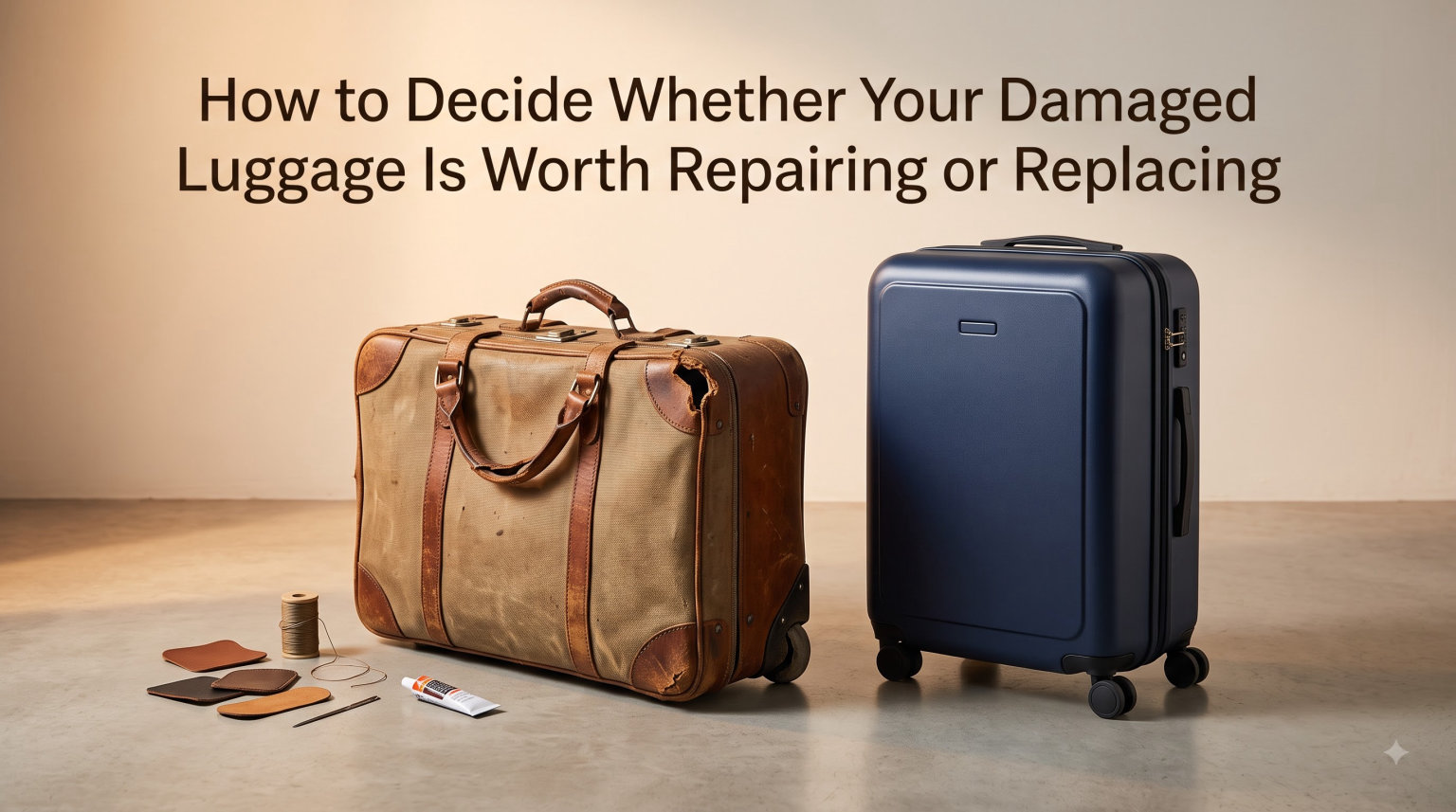
Standing at the baggage carousel and watching your suitcase limp onto the belt with a cracked shell or a dangling wheel is a uniquely frustrating travel moment. Suddenly you face the question every traveler dreads: is this damaged luggage worth repairing or replacing? The answer depends on the type of damage, the cost of spare parts, the age and value of your bag, and whether an airline is actually liable for what happened.
Our team has talked through this decision with frequent flyers, airline ground staff, and repair specialists to build a practical framework that saves you both money and hassle. In most cases, minor damage like a broken wheel or a jammed zipper is worth repairing, while structural cracks or widespread shell damage push you toward replacement.
This guide walks you through exactly how to decide whether your damaged luggage is worth repairing or replacing, step by step. You will learn which damage types are fixable, what real repairs cost, how airline compensation works, and when it is smarter to just walk away and buy new.
Table of Contents
Quick Decision Checklist: Repair or Replace
Before getting into the details, run your damaged suitcase through this fast checklist. If you answer “yes” to most of the repair questions, fixing it makes sense; if you lean toward the replace column, start shopping.
Repair is likely worth it if:
The damage is isolated to a replaceable part like a wheel, zipper slider, lock, or telescopic handle.
Spare parts are still available from the manufacturer or a compatible third-party seller.
The estimated repair cost is less than half the price of a comparable new suitcase.
Your bag is relatively new, still under warranty, or was a premium purchase.
An airline caused the damage and may cover the repair or replacement cost.
Replacement is usually the better call if:
The shell is cracked, deeply dented, or structurally compromised.
Multiple systems failed at once, such as wheels, handle, and zipper.
Spare parts are no longer stocked and your bag is several years old.
The repair quote exceeds the cost of buying a similar quality replacement.
Your suitcase is nearing or past its expected lifespan of roughly five to ten years.
Keep this checklist handy. The sections below explain the reasoning behind each point so you can make a confident, informed call.
Types of Damage That Can Be Repaired
Not all damage is a death sentence for your suitcase. Many of the most common travel injuries are isolated to components that are designed to be swapped out. If the main body of your bag is intact, there is a good chance a targeted repair will bring it back to life.
Wheel Damage and Replacement
Broken or worn-out wheels are the single most repairable type of luggage damage. Most suitcases use spinner wheels attached with retaining pins, screws, or rivets that can be removed with basic tools like a screwdriver or hex key. Replacement wheel sets are widely available online, often for under $30, and many travelers complete this fix themselves in under an hour.
If your bag uses a proprietary wheel design, check directly with the manufacturer. Premium brands like Samsonite, Travelpro, and Briggs and Riley frequently stock replacement wheels specific to their models. When the wheel housing itself is damaged rather than just the wheel, a professional repair service may need to rebuild that section, which raises the cost but is still often cheaper than a full replacement.
Telescopic Handle Repairs
A telescopic handle that jams, sticks, or refuses to lock is annoying but frequently fixable. The issue often stems from debris inside the handle channels, a broken release button, or a stretched internal cable. Cleaning the channels and lubricating the moving parts solves many minor sticking problems at no cost.
When the handle mechanism itself is broken, replacement becomes more involved. You may need to open the interior lining to access the handle frame and cables. Some manufacturers sell replacement handle assemblies, and professional luggage repair shops handle this job regularly. Reddit users report paying around $30 for a handle fix, making it one of the more affordable repairs.
Zipper and Slider Problems
Zipper issues are incredibly common and surprisingly easy to address. A missing or broken zipper slider can be replaced without changing the entire zipper track. Replacement sliders cost only a few dollars, and the swap takes minutes once you know the correct zipper size. A jammed zipper often responds to graphite pencil lubrication or a dab of bar soap along the teeth.
If the zipper tape itself is torn or teeth are missing along a long stretch, the entire zipper may need replacing. This is a more involved job typically handled by a professional or a luggage repair specialist, but it is still within the realm of economically sensible repairs, especially for an expensive bag.
Lock Mechanism Failures
Built-in TSA combination locks occasionally fail to open, jam, or reset incorrectly. In many cases the problem is user error with the combination rather than true mechanical failure. Resetting the lock according to the manufacturer instructions or applying a small amount of lock lubricant often resolves the issue.
When the lock is genuinely broken, replacement lock assemblies are usually available from the manufacturer. The swap requires accessing the lock housing inside the bag, which is a moderate DIY project or a quick job for a repair professional.
Carry Handle Detachment
If a top or side carry handle pulls loose from its mounting points, the fix usually involves re-securing the hardware underneath the lining. In many designs, the handles attach with screws or rivets that can be tightened or replaced. This is a straightforward repair that restores full functionality without touching the rest of the bag.
Types of Damage That Usually Mean Replacement
Some damage goes beyond what a component swap can fix. When the main structure of your suitcase is compromised, repairs become impractical, unsafe, or simply uneconomical. Knowing where that line falls saves you from throwing good money after bad.
Cracked or Split Shells
A cracked hardshell suitcase is the most common type of damage that signals replacement. Polycarbonate and ABS plastic shells do not bond back together reliably. Glue, epoxy, or tape may hold temporarily, but the repaired area loses its impact resistance and will likely crack again under the pressure of a packed bag or rough baggage handling.
Once a shell crack spreads or the material flexes at the damage point, the structural integrity of the entire case is in question. Airlines and baggage handlers apply significant force to luggage, and a weakened shell can fail catastrophically mid-trip, leaving your belongings scattered across a tarmac. In these cases, replacement is the safe and sensible choice.
Deep Dents in Hardshell Luggage
Shallow scuffs and surface scratches on a hardshell are purely cosmetic and do not affect performance. Deep dents, however, indicate that the shell material has been permanently deformed. A dented corner can prevent the case from standing upright, interfere with zipper alignment, or reduce internal capacity.
There is no practical way to pop a deep dent back out of polycarbonate or aluminum without risking further damage. Aluminum suitcases are particularly prone to visible denting, and while the metal may still be structurally sound, the bag will never look or function the same way again.
Torn or Shredded Fabric on Softshell Bags
Small punctures in softshell fabric can sometimes be patched with heavy-duty nylon repair tape, which holds reasonably well for cosmetic damage. But large tears, shredded panels, or damage along stress points like corners and seams are a different story. Fabric repairs on high-stress areas tend to fail quickly because the patched zone is weaker than the surrounding material.
If the tear runs along a main seam or the fabric has separated from the frame, the bag has lost its weather resistance and structural support. Professional re-stitching is possible for localized seam failures, but widespread fabric damage almost always points toward replacement.
Frame and Structural Failure
The internal frame is the backbone of your suitcase. If the frame is bent, cracked, or broken, the bag will not roll straight, close properly, or protect your belongings. Frame damage usually results from severe impacts, and repairing it means essentially rebuilding the suitcase, which is rarely cost-effective.
When you notice your suitcase wobbling, sagging on one side, or no longer sitting flat, frame damage is a likely culprit. At that point, replacement is almost always the right answer.
Hardshell vs Softshell: How Material Changes the Decision
The material your suitcase is made from significantly affects whether damage is repairable. No competitor has thoroughly covered this distinction, so it is worth understanding clearly before you make a decision.
Hardshell luggage (polycarbonate, ABS, aluminum) excels at protecting fragile contents but suffers visibly from impacts. The good news is that hardshells rarely suffer component failures beyond cosmetic scuffing. The bad news is that when the shell itself cracks or dents, there is essentially no viable repair. Hardshell owners should plan to replace when the shell is structurally damaged but can confidently repair wheels, handles, and zippers.
Softshell luggage (ballistic nylon, polyester) hides scuffs and abrasions far better than hardshell cases. Small fabric damage can be patched, and the flexible material resists denting. However, softshell bags are more prone to zipper failures, fabric tearing at stress points, and wheel housing damage where the fabric meets the frame. The repairability of softshell luggage depends heavily on whether the damage is in a patchable area or along a structural seam.
In practical terms, hardshell bags tend to be all-or-nothing: either the shell is fine and you fix small components, or the shell is broken and you replace the whole thing. Softshell bags occupy a gray middle ground where partial repairs are more often viable.
Repair Costs vs Replacement Value: The Real Numbers
The financial question sits at the heart of the repair or replace decision. Luggage repair costs typically range from $30 to $200 depending on the part and labor involved. Knowing where your specific damage falls on that spectrum tells you whether a repair is worth pursuing.
Here is a general breakdown of common repair costs based on data from repair services and traveler reports:
Wheel replacement: $20 to $50 for parts, plus optional labor if you do not DIY.
Telescopic handle repair: $30 to $75, depending on whether cables or the full assembly need replacing.
Zipper slider replacement: $10 to $30 for the part, with professional installation adding labor.
Full zipper replacement: $50 to $100, requiring interior access and re-stitching.
Lock mechanism replacement: $25 to $60 for parts and labor.
Professional multi-part repair: $100 to $200 for complex jobs combining several fixes.
The break-even rule our team follows is simple: if the repair cost exceeds 50 percent of what you would pay for a comparable new suitcase, replacement is the smarter financial move. For a $300 mid-range suitcase, that means repairs up to about $150 are worth considering. For a $100 budget bag, anything beyond a $50 wheel or zipper fix pushes you toward buying new.
You should also factor in depreciation. Airlines calculate compensation based on the depreciated value of your luggage, typically reducing the original value by 10 to 20 percent per year. A five-year-old suitcase that originally cost $200 may only be valued at $80 to $100 by an airline, which affects how much compensation you can realistically claim.
Finally, consider the time value of your luggage. Even a free repair is not worth it if your bag will be out of service for weeks right before a major trip. If a repair takes longer than your travel timeline allows, replacing the bag immediately and pursuing reimbursement separately is often the most practical path.
DIY Repair vs Professional Repair
Many common luggage repairs are well within the abilities of a reasonably handy traveler, while others are best left to professionals. Knowing the difference prevents frustration and avoids making damage worse.
DIY-friendly repairs include wheel replacement, zipper slider swaps, lock resets, and handle cleaning or lubrication. These jobs require minimal tools, usually just a screwdriver, hex key, or pair of pliers, and there are countless video tutorials that walk you through each model. Replacement parts are easy to source online, and completing the repair yourself eliminates labor costs entirely.
Professional repairs are the better choice for full zipper replacements, internal handle mechanism rebuilds, frame-adjacent work, and any repair requiring you to open sealed or riveted sections of the bag. Luggage repair specialists have the right tools and experience to do these jobs cleanly and durably. They can also source OEM parts that may be difficult for a consumer to find.
Before attempting a DIY repair, check your warranty first. Opening the bag or using non-original parts may void a manufacturer warranty that would otherwise cover the repair for free. If your bag is still under warranty, contact the manufacturer directly before picking up a screwdriver.
Age and Lifespan Considerations
The age of your suitcase is a major factor that many travelers overlook. Most quality suitcases are designed to last between five and ten years of regular use, with premium brands sometimes exceeding a decade. Once your bag approaches or passes that range, the math shifts in favor of replacement even for repairable damage.
Older bags are more likely to develop secondary problems shortly after you fix the first one. A seven-year-old suitcase that needs new wheels may also have a zipper on the verge of failing and a handle cable that is wearing thin. Spending money on one repair only to face another bill a few months later is a frustrating cycle.
Our team uses a practical ten-year rule: if your suitcase is a decade old or more, replacement is almost always the better decision regardless of the specific damage. The combination of depreciation, worn materials, and outdated features like non-TSA locks or outdated wheel designs makes investing in repairs poor value at that age.
For newer bags, especially those under three years old and from reputable brands, repairs are generally worthwhile. A two-year-old Travelpro that needs a $40 wheel replacement is an easy yes. The bag has years of useful life ahead, and the repair cost is trivial relative to the original value.
When Spare Parts Are Unavailable
Sometimes the damage is technically repairable, but the parts simply do not exist anymore. This happens frequently with older models, discontinued product lines, or obscure brands. When the manufacturer no longer stocks replacement wheels, handles, or lock assemblies for your specific suitcase, your options narrow significantly.
Third-party universal parts can sometimes fill the gap. Generic spinner wheel sets, universal zipper sliders, and replacement lock mechanisms are sold online and may fit your bag even if they are not from the original manufacturer. The fit is not always perfect, but for a bag you love, it can extend its life by another year or two.
If no compatible parts exist at all and your bag is no longer under warranty, replacement becomes the only realistic path. At that point, consider it an opportunity to upgrade to a newer model with better wheels, lighter materials, and improved security features.
Airline Responsibility: Who Pays for Damaged Luggage
If an airline damaged your luggage, the repair or replace decision may not be yours to finance. Airlines are responsible for damage they cause to checked baggage, and understanding your rights can mean the difference between paying out of pocket and receiving full compensation.
Domestic Flights and Airline Liability
On domestic flights within the United States, the Department of Transportation requires airlines to compensate passengers for damaged baggage. When damage cannot be repaired, airlines negotiate a compensation amount based on the value of the bag and its depreciation. Many airlines prefer to offer a replacement suitcase from their own stock rather than cash, and these offered replacements are frequently lower quality than what you lost.
Reddit travelers consistently report this exact scenario: filing a damage report, being offered a cheap generic replacement bag, and having to push back to receive fair cash compensation instead. The key insight from experienced travelers is to never accept the first offer without understanding the depreciated value of your original bag.
The Montreal Convention for International Flights
For international travel, the Montreal Convention governs airline liability for damaged baggage. No competitor explains this clearly, so here is the simple version: under the Montreal Convention, airlines are liable for damage to checked baggage on international flights up to a specified limit per passenger, currently set around 1,288 Special Drawing Rights (approximately $1,700 USD, adjusted periodically).
This framework applies to most international routes between countries that have ratified the treaty, which includes the vast majority of major travel destinations. The convention shifts the burden onto the airline to prove they were not at fault, which works in your favor when pursuing a damage claim.
Does TSA Pay for Damaged Luggage?
If your luggage was damaged during a TSA security inspection rather than by the airline, the claims process is different. The TSA has its own claims process, and you must file directly with the agency rather than the airline. Claims must be submitted in writing, and the TSA investigates whether the damage occurred during their inspection process.
TSA claims can take several weeks to process, and compensation is not guaranteed. The agency evaluates each claim individually, and they may deny claims if they determine the damage resulted from normal wear or a bag defect rather than inspection handling. Photographs of the bag before and after travel strengthen your case considerably.
Reporting Deadlines Matter
Most airlines require you to report damage before leaving the airport or within a short window, typically seven days, after your flight. Some carriers have even tighter deadlines. If you walk out of the airport without filing a report, your chances of receiving compensation drop dramatically. Always inspect your luggage at the carousel before you leave the baggage claim area.
How to File an Airline Damage Claim (Step by Step)
Filing a damage claim is straightforward when you know the process, but skipping a step can cost you your compensation. Follow these steps in order, and keep documentation of everything.
Step 1: Inspect and photograph immediately. Before leaving the baggage claim area, examine your suitcase thoroughly. Take clear photos of all damage from multiple angles, including close-ups of broken parts and wide shots showing the overall condition. These photos are your primary evidence.
Step 2: Report at the airport. Go directly to the airline baggage service desk before exiting the airport. File a damage report on the spot and get a copy of the reference number or property irregularity report. If no counter is staffed, ask airport staff where to file, since some airports have no permanent damage desk.
Step 3: Gather your documentation. Collect your original luggage receipt or proof of purchase, your boarding pass, baggage tags, and the damage report number. Airlines depreciate luggage value based on age, so having the original receipt establishes the starting value for your claim.
Step 4: Submit a written claim. Many airlines require a formal written claim in addition to the airport report. Submit this through the airline website or customer service portal within their stated deadline, usually seven days for domestic flights.
Step 5: Evaluate the airline offer. When the airline responds, they may offer a replacement bag, a repair, or cash compensation. Compare their offer against the depreciated value of your original bag. If the offer seems low, negotiate and request cash rather than accepting a cheap replacement you did not choose.
Step 6: Follow up persistently. Damage claims can take anywhere from a few weeks to several months to resolve. Keep your claim reference number handy and follow up regularly. If the airline is unresponsive, escalate through the DOT for domestic claims or reference the Montreal Convention for international travel.
Decision Framework: Repair or Replace
Now let us bring everything together into a clear decision framework you can apply to your own damaged luggage. Work through these questions in order, and the right answer will usually reveal itself quickly.
Question 1: Did an airline cause the damage? If yes, file a claim first before spending your own money. The airline may cover the repair or replacement entirely, making the out-of-pocket cost irrelevant. Do not skip this step even if the damage seems minor.
Question 2: Is the damage to a replaceable component? Wheels, zippers, handles, and locks are components designed to be swapped. Shell cracks, deep dents, frame damage, and large fabric tears are structural problems. If the damage is component-level, lean toward repair. If it is structural, lean toward replacement.
Question 3: Are spare parts available? Check with the manufacturer and search for compatible third-party parts. If parts exist and are affordable, repair is viable. If parts are discontinued and unavailable, replacement is your only realistic option.
Question 4: Is the bag still under warranty? A valid manufacturer warranty may cover the repair at no cost to you. Contact the brand before paying for anything. Premium brands like Briggs and Riley offer lifetime warranties that can make repairs essentially free.
Question 5: How old is the suitcase? Bags under five years old are generally worth repairing. Bags between five and ten years are a judgment call based on overall condition. Bags over ten years old are usually better replaced, since additional failures are likely and depreciation has eroded their value.
Question 6: Does the repair cost make financial sense? Apply the 50 percent rule. If the repair cost is less than half the price of a comparable new bag, repair is the smart financial move. If it exceeds that threshold, replacement gives you better value along with a fresh warranty and updated features.
Question 7: Do you need the bag immediately? If a trip is imminent and repairs will take weeks, buy a replacement now and pursue reimbursement or repairs later. Traveling with damaged luggage risks further damage to both the bag and your belongings.
By running your situation through these seven questions, you will land on a confident, well-reasoned decision rather than a guess. The framework works whether you are dealing with a single broken wheel or a suitcase that looks like it lost a fight with a baggage conveyor.
FAQs
Is it worth claiming for a damaged suitcase?
Yes, it is almost always worth filing a claim if an airline damaged your suitcase. Reporting the damage at the airport before you leave and submitting a written claim within the airline deadline, usually seven days, costs you nothing and can result in full compensation for repairs or replacement. Many travelers successfully receive cash compensation by documenting the damage, keeping their original receipt, and negotiating rather than accepting the first low offer.
Is it worth it to repair luggage?
It is worth repairing luggage when the damage is limited to replaceable components like wheels, zippers, handles, or locks, and the repair cost is less than half the price of a comparable new bag. Minor repairs typically range from $30 to $75 and can extend the life of a quality suitcase by several years. Structural damage like cracked shells or bent frames is rarely worth repairing.
Do airlines have to replace damaged luggage?
Airlines are required to compensate passengers for damage they cause to checked baggage. On domestic US flights, the Department of Transportation mandates this responsibility, and on most international flights the Montreal Convention applies with liability limits around $1,700 per passenger. Airlines may offer a replacement bag, a repair, or cash, and you have the right to negotiate for fair compensation based on the depreciated value of your luggage.
Does TSA pay for damaged luggage?
The TSA has its own claims process separate from the airlines. If your luggage was damaged during a TSA security inspection, you must file a written claim directly with the TSA rather than the airline. The TSA investigates each claim and may provide compensation, though approval is not guaranteed and processing can take several weeks. Photographs of your luggage before and after travel strengthen your claim.
What is the average lifespan of a suitcase?
Most quality suitcases last between five and ten years of regular use, with premium brands sometimes exceeding a decade. Factors like travel frequency, baggage handling, and storage conditions all affect longevity. Once a suitcase approaches ten years old, replacement is generally the better decision even for repairable damage, because worn materials and additional component failures make investing in repairs poor value.
Can cracked hardshell luggage be repaired?
Cracked hardshell luggage generally cannot be repaired effectively. Polycarbonate and ABS shells do not bond back together reliably, and temporary fixes like glue or epoxy lose strength under baggage handling pressure, creating a risk of the bag failing mid-trip. When a hardshell cracks, replacement is almost always the safest and most practical choice, even though wheels and zippers on the same bag remain repairable.
Conclusion
Deciding whether your damaged luggage is worth repairing or replacing comes down to four core factors: the type of damage, the availability and cost of parts, the age and value of your bag, and whether an airline owes you compensation. Component damage like broken wheels and jammed zippers is almost always worth fixing, while structural cracks and frame failures point clearly toward replacement.
Apply the 50 percent rule, check your warranty, and always file a claim if an airline is responsible. Run your situation through the seven-question decision framework above, and you will have a clear, confident answer in minutes. The right choice protects both your wallet and your future travels.