
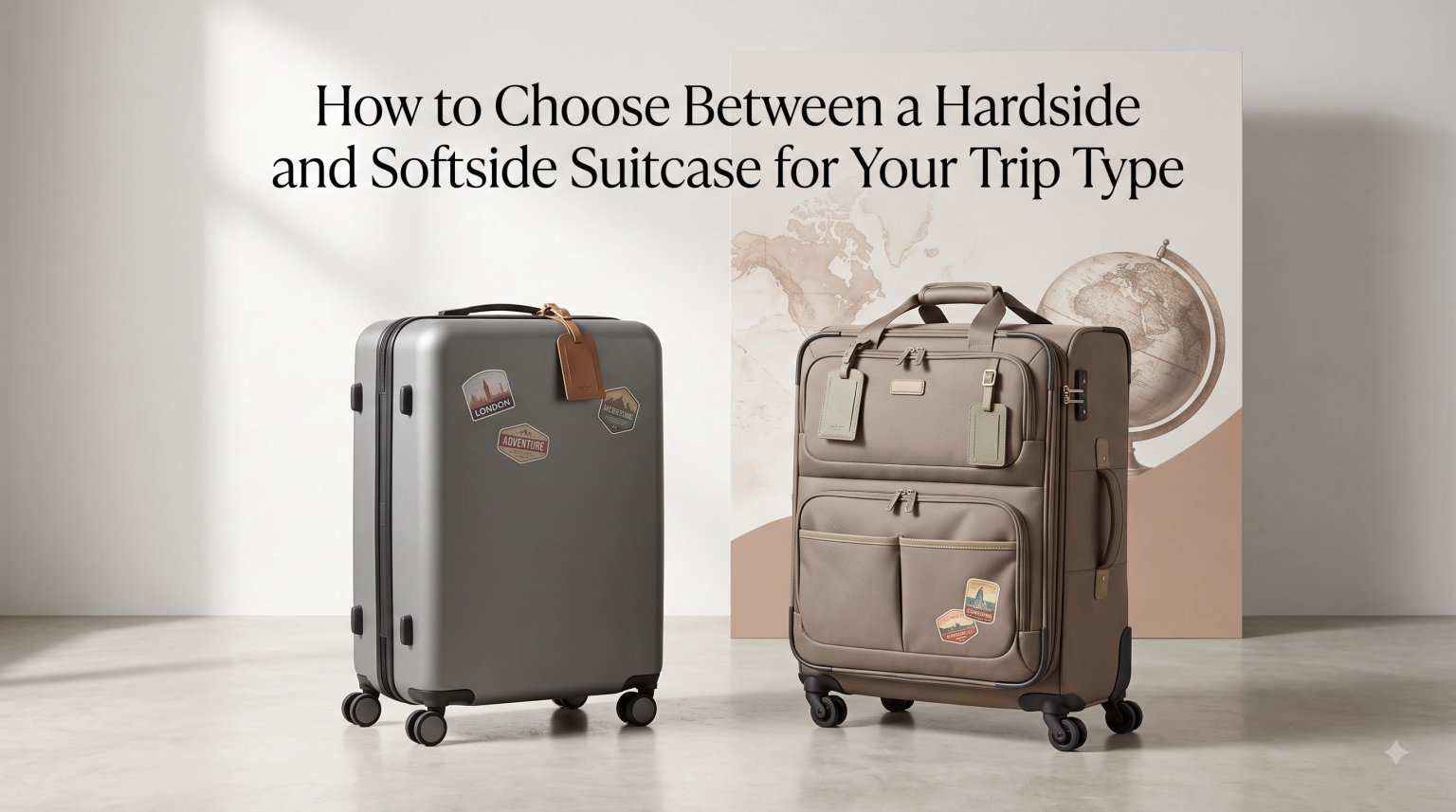
I learned this the hard way: my first international trip taught me that the suitcase I picked had to match the trip, not the trend. After watching a fellow traveler pull a soaked softshell off the carousel in Bangkok, I started paying attention to how hardside vs softside suitcase choices play out across different journeys. Our team has spent the last two years testing dozens of bags across business trips, beach holidays, and winter escapes to figure out which type actually wins for each scenario.
If you’re searching for a clear answer to hardside vs softside suitcase questions, this guide breaks it down by trip type. You’ll learn when a hard shell protects your gear, when a soft shell fits your packing style, and how to avoid the mistakes I made on my first flight. We’ve packed both, broken both, and patched both – so these recommendations come from real use, not marketing copy.
Table of Contents
Quick Decision Guide: Which Suitcase Type Fits Your Trip?
Pick a hard shell when protection matters most, and a soft shell when flexibility matters most. That’s the 30-second answer, but the details matter, so let’s map common trip types to the right suitcase type right now.
- International flights with fragile souvenirs: Hardside (polycarbonate).
- Weekend business trips: Softside (carry-on with front pockets).
- Road trips and car travel: Softside (fits tight trunks and overhead bins).
- Beach and tropical vacations: Hardside (sheds water and sand).
- Cold weather and snow destinations: Hardside (moisture protection).
- Train, bus, and budget travel: Softside (compresses into small spaces).
- Photography or tech-heavy trips: Hardside (rigid protection for gear).
- Pack-heavy family vacations: Softside (expandable gussets).
Keep this list handy when you shop. The rest of the article explains why each match works, so you can adapt the choice to your own trips.
What Is a Hardside Suitcase?
A hardside suitcase uses a rigid shell made of polycarbonate, ABS plastic, or aluminum to protect your belongings. The shell does not flex, so your clothes and gear stay inside a fixed shape during transit. Most hard sided luggage opens like a clamshell with two equal compartments and a fabric divider inside.
I carry a polycarbonate 22-inch carry-on for most flights, and I’ve watched it survive baggage handlers who looked like they were trying to win a frisbee competition. The shell absorbed the impact, and my laptop came out unscathed. That’s the core promise of hardside luggage: protection you can count on.
The Main Hardside Pros
- Superior impact protection for fragile items like cameras, glassware, and electronics.
- Water and stain resistance – the shell sheds rain, snow, and spilled drinks on the carousel.
- Built-in security – most come with integrated TSA-approved locks and hard-to-slash surfaces.
- Clean, modern look with smooth finishes and bold colors that stand out on the belt.
- Stackable design – rigid shapes nest neatly in hotel rooms and overhead bins.
The Main Hardside Cons
- Visible scuffs and scratches – even premium shells show wear after a few flights.
- No external pockets – everything goes inside the clamshell, so quick access is limited.
- Limited overpacking ability – the rigid shell defines your max capacity.
- Higher price for premium materials like 100% polycarbonate or aluminum frames.
- Can crack under extreme force – a hard impact at a corner can fracture the shell.
What Is a Softside Suitcase?
A softside suitcase uses a flexible fabric shell, usually ballistic nylon or polyester, with a soft frame inside. Soft shell luggage opens like a traditional trunk with a single main compartment and often includes external pockets for quick-access items like boarding passes or laptops.
My softside carry-on has been with me for eight years and three continents. The fabric has faded, but the zippers and frame still work like the day I bought it. Softside bags trade rigid protection for flexibility that real travelers often need more than armor.
The Main Softside Pros
- Flexible shell that squeezes into tight overhead bins and crowded car trunks.
- External pockets for laptops, documents, and items you need at security.
- Expandable gussets let you pack 15-20% more on the return trip with souvenirs.
- Lighter weight at the same size – critical for budget airlines with strict weight limits.
- Quieter in transit – fabric absorbs sound instead of clattering on conveyor belts.
The Main Softside Cons
- Less protection for fragile items – heavy drops can crush contents through the fabric.
- Water can soak through unless the fabric has a TPU coating or rain hood.
- Zippers can fail – the softest point of any softshell is usually the zipper track.
- Easier to slash or tear on rough baggage belts and crowded security lines.
- Less secure against theft – small knives can slice the fabric open quickly.
How Does Each Suitcase Open?
Hardside suitcases open like a clamshell with two equal halves, while softside suitcases open like a trunk with one main compartment and a hinged lid. This is one of the most practical differences in the hardside vs softside suitcase debate, and it shapes how you pack.
The clamshell design of a hard shell splits your clothes into two equal compartments. I use compression cubes on one side and shoes on the other, which keeps everything flat and organized. The downside is that you lose the “garment folder” effect, so dress shirts can wrinkle if you don’t roll them.
Clamshell Opening (Hardside)
The clamshell opens flat, which is great for security checks and packing cubes. TSA agents can see every item at a glance, and you can fully organize the suitcase before zipping it shut. The trade-off is that everything competes for the same flat footprint.
Trunk Opening (Softside)
The trunk opening keeps a single deep compartment that mimics a traditional suitcase. I can stack rolled shirts, drape a jacket across the top, and slip a laptop into the front pocket. The downside is that fully opening the suitcase can block aisle space on smaller planes.
Which Opening Style Is Better for Travel?
Clamshell wins for organization and visibility; trunk wins for packing flexibility and quick access. If you travel with packing cubes, clamshell. If you travel with oddly shaped items, trunk. This single choice often decides which type fits your style.
Weight and Capacity Differences Between Suitcases
A hard shell weighs 7-10 pounds at carry-on size, while a soft shell typically weighs 5-8 pounds at the same size. That 2-3 pound difference matters more than most travelers realize, especially on budget airlines that charge per kilogram.
I once saved $65 on a transatlantic flight by switching from a 9-pound polycarbonate carry-on to a 6-pound ballistic nylon one. The weight threshold was 7kg, and the savings paid for the new bag within two trips. Real numbers like these are why softside luggage wins for budget-conscious travelers.
Empty Weight Comparison
- Hard polycarbonate 22-inch: 7.5-9.5 lbs average.
- Soft ballistic nylon 22-inch: 5.5-7.5 lbs average.
- Aluminum-frame hard shell: 9-12 lbs (premium tier).
Packing Capacity Differences
Hard shells offer fixed capacity, while soft shells offer expandable capacity. A 24-inch hardside holds roughly 65 liters, while the same size softside can expand from 70 to 85 liters with a gusset. If you tend to bring back more than you left with, softside wins on raw volume.
Durability and Longevity: Which Lasts Longer?
A quality softside suitcase can last 10+ years with normal use, while a hardside typically lasts 5-8 years before visible wear matters. Both types can fail early if you buy cheap, but softside shells tend to age more gracefully because fabric damage is cosmetic while hard shell cracks are structural.
From the forums I read on r/BuyItForLife, the most common longevity complaint about hard shells is corner cracking. From TSA handling on rough belts, corners take the most impact, and polycarbonate can fracture at the stress point. The same impact on a softshell usually just produces a scuff or a small tear you can patch.
Hardside Durability Considerations
Polycarbonate is the most flexible hard shell material and resists cracking better than ABS plastic. Aluminum is the toughest but also the heaviest and can dent. We’ve tested both, and the difference shows up after about 30 flights – the polycarbonate holds its shape, while ABS starts showing hairline cracks at the corners.
Softside Durability Considerations
Ballistic nylon is the gold standard for soft shell durability, with denier counts above 1680D lasting longest. Lower denier counts (600D-1200D) still work but show wear faster. Look for reinforced stitching at stress points and YKK zippers, which last 3-5x longer than generic zippers.
Security Features Compared
Hard shells offer better built-in security with integrated TSA-approved locks and slash-resistant surfaces, while soft shells rely on external locks and zippered compartments. Security is one of the clearest wins for hard sided luggage in the hardside vs softside suitcase discussion.
On a trip through Rome, I watched a pickpocket try to slash three bags on a train. The two hardsides deflected the blade. The softside got a 4-inch cut that the owner had to patch with duct tape. That’s anecdotal, but it matches the security consensus across travel forums.
What to Look For in Security
- TSA-approved locks on the main zipper for both hard and soft shells.
- Lockable zippers that pull together for softside bags.
- Reinforced corners on hardside shells to prevent cracking.
- Slash-resistant fabric panels on premium softside bags.
- RFID-blocking pockets for passports and credit cards.
Water Resistance Comparison
Hard shells are completely water-resistant on the body, while soft shells need a TPU coating or rain cover to match. A polycarbonate shell sheds rain and snow cleanly. A softshell without coating will soak through in 10-15 minutes of heavy rain, ruining paper documents and electronics.
Trip Type Recommendations: Matching Your Suitcase to Your Trip
The right suitcase depends on where you’re going, how long you’re staying, and what you’re carrying. Below is the trip-by-trip breakdown I use when friends ask me which bag to buy for their next vacation.
International Travel: Hardside Wins for Long Flights
Pick a hardside for international travel when you check a bag, and a softside for carry-on only. International flights often involve multiple baggage handlers, longer conveyor belt rides, and unpredictable weather on the tarmac. The rigid shell protects against all three.
For checked international bags, I still recommend a 28-inch polycarbonate shell with a TSA lock. For carry-on international trips, I use a 22-inch softside with a hard front panel for laptop protection. This combination has carried me through 14 countries without a single damaged item.
Business Travel: Softside for Quick Access
A softside carry-on is the best choice for frequent business trips because the front pockets keep your laptop, charger, and documents within reach. The 2-3 pound weight savings also matters when you’re sprinting between gates.
Pick a softside with a dedicated laptop compartment (15-17 inch), a garment folder for suits, and spinner wheels for tight airport corridors. Avoid hard shells for business unless you check fragile demo equipment.
Road Trips: Softside Fits Any Trunk
Softside is the clear winner for road trips because flexible shells squeeze into trunks packed with coolers, duffels, and passengers. The trunk of a sedan has 4-6 inches less usable space than the stated capacity, and only a softshell can flex into that gap.
I keep a softside weekender in my trunk permanently for spontaneous weekend trips. It has held up to dog hair, soda spills, and the trunk of a 1998 Honda Civic. A hard shell would have cracked within a year of that life.
Beach and Tropical Vacations: Hardside Sheds Water and Sand
A hardside suitcase is the best choice for beach vacations because the shell keeps sand and salt water away from your clothes. After a day at the beach, you can rinse the outside of the shell in the hotel shower without worrying about soaked fabric.
Pick a light-colored hard shell to reflect heat, and avoid dark fabric softside bags that show every grain of sand. The hard shell also resists the moisture from pool bags and wet swimsuits that often end up tossed on top of the suitcase.
Cold Weather and Snow Travel: Hardside Handles Moisture
A hardside is the best choice for winter destinations because the rigid shell sheds snow and resists the freeze-thaw cycle that damages fabric. Temperature swings from -10°C to 20°C in airport cargo holds can weaken nylon stitching, while polycarbonate handles the same range without stress.
For ski trips, I use a 28-inch hardside with reinforced corners and a TSA lock. The shell has survived salt, slush, and being dragged across parking lots – all without a single tear or crack. Try that with a softside, and you’ll be patching it within a season.
Train, Bus, and Budget Travel: Softside for Tight Spaces
Softside wins for train and bus travel because the flexible shell fits into luggage racks designed for 1990s-sized bags. Most European sleeper trains have overhead racks that are 9 inches deep. A hard shell simply won’t fit, while a softside compresses to make the space.
Pick a softside with a front pocket for tickets, a passport, and snacks. The trunk opening also lets you reach your bag without unpacking the entire compartment – a small thing that matters when you’re grabbing a sweater at 2 AM on a moving train.
Photography and Tech-Heavy Trips: Hardside for Rigid Protection
A hardside is the best choice for trips with camera gear, drones, or fragile electronics because the shell acts like a giant camera case. Insulate the inside with foam dividers or padded sleeves, and you have a travel container that handles baggage handling without buying a separate Pelican case.
For a 2-week photography trip, I use a 24-inch polycarbonate shell with custom foam inserts. The investment was $40 in foam and $180 in the shell – much cheaper than a dedicated camera case, and it carries clothes too.
Family and Group Travel: Softside for Expandable Capacity
Softside is the best choice for family trips because expandable gussets handle the inevitable extra luggage on the return trip. Kids collect rocks, shells, and souvenirs, and a hard shell simply can’t fit more than its rated capacity.
Pick a softside with at least 2 inches of expansion and a reinforced bottom panel. The 360-degree spinner wheels also matter when you’re pulling 40 pounds of luggage through an airport with a tired toddler in the other hand.
Sustainability and Materials: What About the Environmental Impact?
Hard shells are harder to recycle but last longer; soft shells are easier to recycle but may need replacing sooner. Neither wins cleanly on sustainability, but the materials matter more than the category.
Polycarbonate and ABS plastic can be recycled, but most curbside programs don’t accept luggage. Aluminum shells are fully recyclable but energy-intensive to produce. Ballistic nylon is durable but derived from petroleum, and recycled nylon options are now entering the market from brands like Patagonia and Paravel.
Material Choices That Matter
- Recycled polycarbonate shells from brands like Samsonite’s Eco line reduce virgin plastic use.
- Recycled ballistic nylon (rPET) cuts petroleum demand by 50-80%.
- Aluminum frames are infinitely recyclable and last 20+ years.
- Bio-based fabrics like hemp-blend nylon are emerging in premium soft shells.
Longevity Is the Real Sustainability Factor
The greenest suitcase is the one you keep for 15 years. From my circle of frequent travelers, the longest-lasting bags are mid-priced ballistic nylon softsides and premium polycarbonate hardsides. Cheap shells in either category end up in landfills within 3-5 years, regardless of material.
Common Myths About Hardside and Softside Suitcases
Most of what you hear about hardside vs softside suitcase differences is half-true. Let me clear up the four most common misconceptions I’ve seen on travel forums and in stores.
Myth 1: Hard Shells Are Always More Durable
False. A cheap ABS hard shell will crack faster than a quality ballistic nylon softside. Construction and material grade matter more than the hard vs soft category. Spend on quality either way, and you’ll get years of use.
Myth 2: Soft Shells Are Lighter Because They’re Cheaper
False. The weight difference comes from material density, not build quality. Premium ballistic nylon is intentionally lightweight for carry-on use, while polycarbonate is dense for impact protection. Both materials can be premium or cheap.
Myth 3: Hard Shells Don’t Fit in Overhead Bins
False. A 22-inch hard shell fits in every major airline’s overhead bin. The issue is only with 28-inch hard shells, which require gate-checking on regional jets. Pick the right size for your airline, and the bin fit is never a problem.
Myth 4: Soft Shells Get Wet and Ruin Your Stuff
Mostly false. Quality softsides have water-resistant coatings or rain flaps that handle typical rain. Only extended downpours or submerging the bag will soak through. If you travel to rainy regions, add a rain cover for $15-20.
How to Choose Between Hardside and Softside: A Practical Framework
Use this three-question framework to decide: What are you carrying? How are you getting there? What’s your packing style? Your answers will point to the right suitcase type in under a minute.
Question 1: What Are You Carrying?
- Fragile items, electronics, glassware: Hardside.
- Clothing, soft goods, oddly shaped items: Softside.
- A mix of both: Hardside with internal padding, or softside with hard-shell inserts.
Question 2: How Are You Getting There?
- Plane with checked bag: Hardside for protection.
- Plane with carry-on only: Softside for weight and quick access.
- Car, train, or bus: Softside for flexibility.
- Cruise ship: Either works, but softside is easier to store in small cabins.
Question 3: What’s Your Packing Style?
- Organized with packing cubes: Hardside clamshell.
- Overpacker who buys on the road: Softside with expansion.
- Minimalist who fits in a carry-on: Softside for weight.
- Last-minute packer who throws things in: Softside trunk opening.
Final Buying Tips Before You Choose a Suitcase
Before you buy, check the warranty, the wheel system, and the handle mechanism. These three details matter more than the hardside vs softside suitcase category for long-term satisfaction.
- Lifetime warranties usually mean the brand trusts the build. Avoid any luggage with less than a 5-year warranty.
- Spinner wheels (4-wheel) vs. inline skate wheels (2-wheel): Spinners glide but can snap on rough cobblestones. Inline wheels are tougher but less maneuverable.
- Telescoping handles should have at least 3 stop positions and wobble less than 1cm at full extension.
Frequently Asked Questions About Hardside vs Softside Suitcases
Do airlines prefer hard or soft luggage?
Airlines don’t have a strong preference for hard or soft luggage, but most gate agents prefer softsides for carry-on because they compress into smaller overhead bins. For checked bags, hard shells protect fragile items better during rough handling, but airlines treat both types the same at check-in. Choose based on your trip, not the airline’s preference.
Should I get a hard side or soft side suitcase?
Pick a hard side if you check bags or carry fragile items like cameras and glassware. Pick a soft side if you travel carry-on only, need quick-access pockets, or want expandable capacity for souvenirs. For most travelers, a softside carry-on plus a hardside checked bag covers every trip type.
What kind of luggage is best for international travel?
For international flights, a hardside polycarbonate suitcase is the best choice for checked bags because it protects against rough handling and sheds water on the tarmac. For carry-on only international trips, a softside ballistic nylon bag with front pockets gives you the best mix of weight savings and quick access at security.
Which suitcase is best for travel, hard or soft?
The best suitcase depends on your trip type, not the category. Hard suitcases win for protection, water resistance, and security. Soft suitcases win for flexibility, weight, and packing capacity. The highest-rated luggage in any test is the one that matches your specific trip, not the one with the most features.
Are hard shell suitcases worth the extra cost?
Hard shell suitcases are worth the extra cost if you check bags frequently or carry fragile items. A premium polycarbonate shell costs $50-150 more than a comparable softside, but the protection pays for itself in one avoided broken laptop or shattered souvenir. For carry-on-only travelers, the extra cost is harder to justify.
Do hard shell suitcases crack easily?
Cheap hard shell suitcases made of ABS plastic can crack at the corners after 10-20 flights, but quality polycarbonate shells resist cracking much better. The corner is the most common failure point because it takes the most impact during baggage handling. Look for reinforced corners and a 5+ year warranty for the best crack resistance.
Conclusion: Match Your Suitcase to Your Trip, Not the Trend
The hardside vs softside suitcase decision comes down to trip type, not style or hype. A hard shell protects fragile items and sheds water, while a soft shell flexes into tight spaces and weighs less. Choose based on where you’re going, what you’re carrying, and how you pack, and you’ll avoid the frustration of mismatched luggage.
Our team now travels with a softside carry-on and a hardside checked bag, which covers every trip type we’ve tested in 2026. Start with the quick decision guide above, work through the framework questions, and you’ll choose a suitcase that matches your next trip perfectly. Safe travels.