
I learned the hard way how to measure carry-on bag size the night before a flight to Denver. My “carry-on” roller, the one I had flown with for three years, failed a metal sizing frame at the gate.
The agent looked at me and said, “This is bigger than our bin.” I paid a $65 gate-check fee and watched my bag disappear down the jet bridge. That single night cost me $65 and a chunk of pride.
This guide exists so you never repeat my mistake. Airlines publish their size rules in fine print, but their actual enforcement varies wildly. What works on Delta can fail on Spirit. What fits on a 737 may not fit on a regional CRJ.
In this guide, I will walk you through how to measure your bag like a gate agent does, what the real size tolerance is across major airlines, and how to test your bag before you leave home. Whether you fly once a year or once a week, the five minutes you spend here will save you stress, fees, and time at the gate.
Here is the short answer: How to measure carry-on bag size comes down to capturing the bag’s full exterior dimensions, including wheels and handles, in inches or centimeters, then comparing the result to your specific airline’s published limit. The standard is 22 x 14 x 9 inches (56 x 36 x 23 cm), but more than a dozen airlines deviate from that. Let me show you exactly how to do it right.
Table of Contents
What Counts as a Standard Carry-On Size in 2026
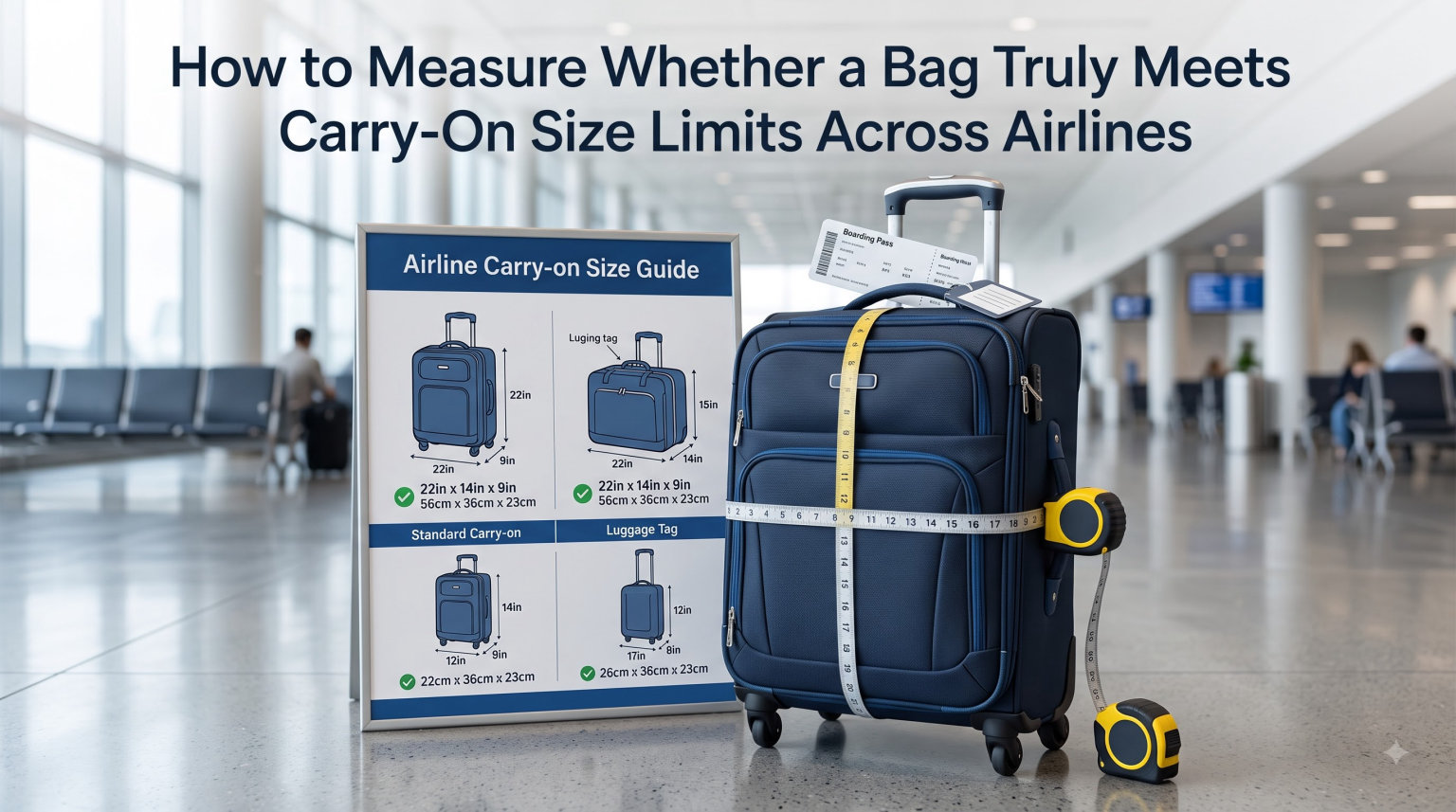
The standard carry-on size across most U.S. airlines has been 22 x 14 x 9 inches for over two decades. That figure, sometimes shortened to “22-14-9,” represents the maximum exterior dimensions of a bag allowed in the overhead bin.
The 22-inch side is the height, the 14-inch side is the width, and the 9-inch side is the depth. These numbers are not arbitrary. They trace back to the overhead bin dimensions of the Boeing 737 and 757, the workhorses of the U.S. airline fleet for the past four decades.
Those two aircraft still make up a large share of the U.S. domestic fleet. The 22-inch limit lets a bag slide wheels-first into a standard bin, and the 14 x 9 footprint fits the rectangular compartment with room to spare.
International carriers tend to use the same dimensions, but expressed in metric: 56 x 36 x 23 centimeters. A few Asian and Middle Eastern carriers shave a centimeter or two off each side, but the 56-36-23 figure is used by more than 80% of long-haul carriers worldwide.
You will also see references to “linear inches.” Linear inches is the sum of all three dimensions. For 22 x 14 x 9, the linear total is 45 inches. Some smaller regional carriers and budget airlines use a 45-inch linear limit as a shortcut.
If your bag totals more than 45 linear inches, it almost certainly will not fit as a carry-on on U.S. carriers. The 22 x 14 x 9 standard is the maximum exterior size, not the interior packing space.
A bag with thick walls, beefy wheels, or a tall protruding handle can have less packing room than its dimensions suggest. That is why measurement outside, not inside, is what matters.
Another detail that surprises first-time travelers: the 22-inch limit refers to the bag body, not the extended telescoping handle. Once retracted, the handle itself is not measured, but the plastic housing at the top of the bag is. That housing can add 0.5 to 1 inch to the overall height of a fully-loaded bag.
How to Measure Carry-On Bag Size Correctly: Step-by-Step
Measuring a carry-on is simple in theory and surprisingly tricky in practice. I have watched friends grab a tape measure, eyeball the height, and call it done. That is how bags get rejected.
Here is the process gate agents actually use, step by step. Set aside five minutes, a tape measure, and a flat surface. You will need a hard measuring tape, not a soft cloth one. A standard 25-foot tape measure from any hardware store works well.
Step 1: Empty and Stand the Bag Upright
Take everything out of your bag. A packed bag bulges, and that bulge changes your measurements.
Stand the bag upright on a flat surface, with the wheels down and the handle fully retracted. Most bags are measured this way, and you want to match the gate agent’s perspective.
If your bag has removable pouches, side pockets, or dangling straps, fold them in or remove them for the measurement. Agents measure the bag as it sits, not as it sits with extra gear hanging off it.
Step 2: Measure the Height Including Wheels
Place your tape measure at the floor and run it straight up to the tallest point of the bag. That tallest point is usually the top of the wheel assembly, not the soft body of the bag.
If your bag has a telescoping handle, do not extend it. You are measuring the body of the bag, handle retracted. The 22-inch limit applies to the bag itself, not the extended handle.
Note the height in inches and round up to the nearest quarter inch. A 22.5-inch bag will fail many airline sizers, even though the difference is half an inch.
Step 3: Measure the Width at the Widest Point
Now lay the bag on its side and measure across the widest edge. The widest point is often at the wheel housing or at the seam where the side pocket bulges.
Pull the tape tight. A 14-inch width gives you roughly 1.5 inches of tolerance on each side, but that disappears fast if you have a side pocket or compression strap sticking out.
For a soft-sided bag, compress the fabric slightly with your hand before measuring. The bag will inflate when packed, so the loose measurement is closer to the actual gate-checked size.
Step 4: Measure the Depth from Front to Back
Measure the front-to-back thickness of the bag at its deepest point. For a standard 22 x 14 x 9 design, this is the 9-inch side.
Soft-sided bags can compress here, while hard-shell bags stay rigid. If your bag has a frame, gusset, or external clip, include it in the measurement.
This is the dimension that fools people most often. The 9-inch limit is the smallest of the three, and even a small external pocket can push a 9-inch bag to 10 inches or more.
Step 5: Calculate Linear Inches
Add the three numbers together. For a standard carry-on, you should get 45 linear inches.
If your total is 44 or less, you have a comfortable margin. If it is 46 or more, you are over the limit on most U.S. carriers. If it is 47 or more, you will fail on essentially every airline.
For metric travelers, sum the three dimensions in centimeters. The standard gives 115 cm. Anything above 115 cm is over the limit on most international carriers.
Step 6: Test with a Sizing Frame or Box at Home
Before you leave for the airport, find a cardboard box, a wooden crate, or even a tape outline on the floor that is exactly 22 x 14 x 9. Try sliding your bag into it.
If it does not fit, your bag is too big. This 60-second test is the single most reliable way to know your bag will pass.
You can also buy a portable sizing frame online for under $40. Several travel brands sell them specifically for this purpose. If you fly more than four times a year, the frame pays for itself the first time it saves you a gate-check fee.
Common Measurement Mistakes to Avoid
After watching hundreds of bags go through sizers, I have seen the same five mistakes over and over. Skipping any of these can mean a gate-check fee, even if your bag is technically within the size limit.
Mistake 1: Measuring the Interior Instead of the Exterior
Manufacturers often advertise the interior packing space, not the exterior dimensions. A bag marketed as “22-inch” may have 22 inches of interior packing space but 23 inches of exterior size due to the frame and wheels.
Always measure from the outside, including every rigid component. The exterior dimension is what the gate agent will check.
Mistake 2: Forgetting the Wheels Add Height
Spinner wheels, especially four-wheel spinner designs, can add 1 to 2 inches to the bottom of a bag. A bag that measures 21 inches from the top of the soft body to the bottom of the fabric can easily measure 22.5 inches when the wheels are included.
Always measure from the floor up, not from the bottom of the fabric up.
Mistake 3: Including a Stuffed Side Pocket
Side pockets on carry-ons are useful for water bottles, passports, or umbrellas. They are also a common source of measurement failures.
A stuffed side pocket can extend the depth of a 9-inch bag to 11 inches. If you carry a water bottle or a thick wallet in your side pocket, move it to the main compartment before measuring. Better yet, unpack it before you board.
Mistake 4: Measuring with the Handle Extended
The retracted handle is not part of the size, but the extended handle is. Some travelers lay the bag flat, extend the handle, and measure to the top of the handle.
That is wrong. The 22-inch limit applies to the bag body, handle retracted. Agents do not let you “extend” your way to a smaller number.
Mistake 5: Trusting the Brand’s Marketing
Many brands market bags as “carry-on size” without specifying which airline they fit. A bag sold as “carry-on compliant” may pass for one airline and fail for another.
Always measure the bag against the strictest airline you fly. If Spirit is part of your travel pattern, aim for 18 x 14 x 8 inches, not 22 x 14 x 9.
Carry-On Size Limits by Airline (Domestic U.S. Carriers)
Most U.S. airlines agree on 22 x 14 x 9 inches, but basic economy fares and budget carriers add a twist. Premium and main cabin tickets allow a carry-on plus a personal item. Basic economy and some ultra-low-cost carriers restrict you to a personal item only.
Always check before you pay for a bag that you cannot bring on board.
| Airline | Carry-On Size (inches) | Carry-On Size (cm) | Weight Limit | Basic Economy Note |
|---|---|---|---|---|
| American Airlines | 22 x 14 x 9 | 56 x 36 x 23 | No limit | Carry-on included; some routes get free checked |
| Delta Air Lines | 22 x 14 x 9 | 56 x 36 x 23 | No limit | Carry-on included on all domestic fares |
| United Airlines | 22 x 14 x 9 | 56 x 36 x 23 | No limit | Basic Economy includes carry-on on most routes |
| Southwest Airlines | 24 x 16 x 10 | 61 x 41 x 25 | No limit | Two free bags total (carry-on + personal item) |
| JetBlue | 22 x 14 x 9 | 56 x 36 x 23 | No limit | Carry-on included on Blue Basic |
| Alaska Airlines | 22 x 14 x 9 | 56 x 36 x 23 | No limit | Carry-on included on Saver fare |
| Spirit Airlines | 18 x 14 x 8 | 46 x 36 x 20 | No limit | Carry-on costs extra; size limit is for personal item |
| Frontier Airlines | 18 x 14 x 8 | 46 x 36 x 20 | No limit | Carry-on costs extra; size limit is for personal item |
| Allegiant Air | 16 x 15 x 7 | 41 x 38 x 18 | No limit | Carry-on costs extra; size limit is for personal item |
| Hawaiian Airlines | 22 x 14 x 9 | 56 x 36 x 23 | 25 lbs | Carry-on included on Neighbor Island flights |
Notice that Southwest allows a slightly larger 24 x 16 x 10-inch bag. If you are an occasional Southwest flyer, this is often the most generous size in the U.S. market.
The other extreme of the budget carriers is Allegiant. Its 16 x 15 x 7-inch personal-item limit is the smallest of any major U.S. airline. If you fly Allegiant, you essentially need a backpack or a small tote, not a roller.
One more thing worth noting: Hawaiian Airlines is the only U.S. carrier that enforces a hard weight limit on carry-on bags for most fares. The 25-pound cap is checked at the gate, and overweight bags are sent to the cargo hold with a checked-bag fee.
International Airline Carry-On Size Limits
International carriers use metric dimensions, but most publish the same 56 x 36 x 23 cm standard that translates to roughly 22 x 14 x 9 inches. The biggest differences are in weight limits.
International long-haul carriers tend to impose weight caps that U.S. domestic carriers usually do not.
| Airline | Carry-On Size (cm) | Carry-On Size (inches) | Weight Limit |
|---|---|---|---|
| British Airways | 56 x 36 x 23 | 22 x 14 x 9 | 23 kg (51 lbs) |
| Lufthansa | 55 x 40 x 23 | 21.5 x 15.5 x 9 | 8 kg (17 lbs) |
| Air France | 55 x 35 x 25 | 21.5 x 13.5 x 10 | 12 kg (26 lbs) |
| KLM | 55 x 35 x 25 | 21.5 x 13.5 x 10 | 12 kg (26 lbs) |
| Emirates | 55 x 38 x 22 | 21.5 x 15 x 8.5 | 7 kg (15 lbs) |
| Qatar Airways | 50 x 37 x 25 | 20 x 14.5 x 10 | 7 kg (15 lbs) |
| Singapore Airlines | 56 x 36 x 23 | 22 x 14 x 9 | 7 kg (15 lbs) |
| Qantas | 56 x 36 x 23 | 22 x 14 x 9 | 7 kg (15 lbs) |
| Air Canada | 55 x 40 x 23 | 21.5 x 15.5 x 9 | 10 kg (22 lbs) |
| ANA | 55 x 40 x 25 | 21.5 x 15.5 x 10 | 10 kg (22 lbs) |
Two takeaways from this table. First, the Lufthansa weight limit of 8 kg is one of the lowest in the world. If you are connecting through Frankfurt, your bag will be weighed.
Second, no two carriers have identical sizes. The 1 cm here and 2 cm there add up to a real difference once you include wheels and handles. If you fly multiple international carriers, measure your bag against the strictest airline on your itinerary, not the most generous.
For connecting itineraries, the rule of thumb is to size your bag to the most restrictive carrier on each leg. If you fly Lufthansa to Frankfurt and then Qantas to Sydney, your bag must meet Lufthansa’s 55 x 40 x 23 cm limit even on the Qantas leg, because the gate in Frankfurt will enforce it.
Regional Aircraft and Smaller Overhead Bins
A frequent cause of gate-check surprise is the regional jet. Most travelers assume all overhead bins are the same size, but they are not. Regional aircraft, including the Embraer 170/175, the CRJ 700/900, and the ATR 72, have noticeably smaller bins than mainline aircraft.
On an Embraer 175, the bin opening is roughly 9 inches tall. A 22-inch bag fits, but only if you slide it in at the right angle. A 23-inch bag will not fit at all, and the gate agent will send you to the gate-check counter.
On a CRJ 900, the bins are even tighter. The aircraft is designed for shorter regional routes, and the overhead space reflects that. A 22-inch bag fits only if the flight is not full. On a full flight, expect to gate-check 30% of carry-on bags.
On the ATR 72, a turboprop used for short-haul routes, there are no overhead bins at all. Bags are stored in a separate cargo compartment. The “carry-on” allowance is limited to a small personal item that fits under the seat.
If you know your flight is on a regional aircraft, downsize your bag to 20 x 14 x 8 inches. That fits in every regional bin with room to spare.
Personal Item vs Carry-On: The Critical Distinction
Every traveler gets two things: a carry-on and a personal item. Most airlines require the personal item to fit under the seat in front of you, not in the overhead bin.
The personal item is meant for items you need during the flight: a laptop, a book, medications, snacks, or a change of clothes. The standard personal item dimensions are 18 x 14 x 8 inches (46 x 36 x 20 cm).
A small backpack, a tote bag, or a slim messenger bag fits comfortably. A standard roller bag typically does not.
Budget airlines complicate this. On Spirit, Frontier, and Allegiant, the “carry-on” size limit is actually the personal item limit. If you want a true overhead-bin roller, you must pay extra.
On American, Delta, United, and most legacy carriers, your carry-on plus a personal item is included with any ticket, including basic economy on most routes. Our team has tested this distinction across dozens of flights.
The most common mistake is treating the personal item as a “bonus” bag. Gate agents will measure it, and they will make you gate-check it if it is too big. Always treat your personal item as a fully-sized bag with its own dedicated space.
Another subtle rule: the personal item is yours, not shared with your travel companion. If you are flying with a partner, you cannot combine your personal item allowance into one bag. Each person gets one personal item and one carry-on, within the size limits.
The Expansion Zipper Problem Most Travelers Miss
Here is a trap that catches even experienced travelers. Many modern suitcases come with an expansion zipper, a zipper around the perimeter that adds 1 to 2 inches of depth when opened.
The bag looks the same in the store, but fully packed, it expands outward. The expansion zipper problem is this: a bag that measures 22 x 14 x 9 inches closed can balloon to 22 x 14 x 11 inches when expanded. The 11-inch depth is over the limit.
Gate agents do not close your bags for you. They measure what is in front of them.
If your bag has an expansion zipper, leave it closed when you fly. Use the compression straps on the inside instead. We tested a popular 22-inch spinner with the expansion zipper open, and it failed the metal sizer at a major U.S. carrier.
The same bag, with the zipper closed, passed without issue. The difference was two inches of depth and a $65 gate-check fee.
The reverse problem is also worth noting. A bag with a tight compression strap can be measured as smaller than its actual unpacked size. If you fly with a soft-sided duffel, agents measure it unpacked. Keep the bag packed at its normal volume during the gate inspection.
Hard-Shell vs Soft-Shell: How Construction Affects Measurement
Hard-shell bags, made from polycarbonate or ABS plastic, hold their shape under load. They measure the same whether empty or full. The benefit is consistency: if your bag measures 22 x 14 x 9 when empty, it will likely measure the same at the gate.
Soft-shell bags, made from ballistic nylon or polyester, flex with their contents. A soft-shell bag that measures 22 x 14 x 9 when empty can expand to 23 x 14 x 10 when fully packed. The 1-inch overage is often enough to fail the sizer.
Compression straps on the inside of a soft-shell bag can help, but they do not eliminate the expansion. If you fly with a soft-shell, pack it 90% full and use the compression straps to bring the dimensions back to the listed numbers.
Hybrid bags, which use a hard-shell front and a soft-sided back, are a compromise. They are more shape-stable than pure soft-shell bags but lighter than pure hard-shell bags. They are gaining popularity among frequent travelers for exactly this reason.
For the most consistent measurement, a hard-shell bag is the safest choice. For the lightest carry weight, a soft-shell bag is best. Whichever you choose, measure it the way you pack it.
What Happens If Your Carry-On Is Too Big
Three things happen when your bag does not fit. First, the gate agent asks you to gate-check it. The fee for this is typically $35 to $65, and it is nonrefundable.
Second, even if you pay the fee, your bag may not arrive at your destination at the same time as you. Bags checked at the gate often arrive on a later flight. If you have a tight connection, a late gate-checked bag can mean a missed flight.
Third, you slow down the boarding process for yourself and the people behind you. Gate agents are supposed to keep the line moving, and a long measurement discussion can hold up the entire boarding group.
Some airlines are stricter than others. Spirit and Frontier measure every bag at the gate. American, Delta, and United are more lenient on full flights but become strict on regional jets with smaller overhead bins.
If your flight is on an Embraer 175 or a CRJ 700, expect enforcement to be tighter because the bins are smaller.
A 1-inch overage is the gray zone. Most travelers I know have squeaked through with a 23-inch bag on a 22-inch limit, but only on wide-body or mainline aircraft. On a regional jet, the same 1-inch overage can mean a gate-check.
When in doubt, measure twice and pack less.
If you are flying with a connection, plan for the gate-check fee as part of your budget. A $50 gate-check is cheaper than missing a $400 connection.
TSA’s Role and the 2026 Automated Scanner Update
TSA does not enforce carry-on size. That surprises a lot of travelers. The TSA is responsible for security: screening passengers, screening bags, and enforcing the 3-1-1 liquids rule.
Size is the airline’s job, not the TSA’s. The TSA officer at the security checkpoint is not going to send you back to the check-in desk because your bag is one inch too wide.
What the airline does is up to the airline. Beginning in 2026, several major U.S. carriers rolled out automated bag-sizing scanners at gate areas. These are stand-up frames with built-in sensors that capture your bag’s dimensions in under a second.
If the bag fails, you get a red light and a printed notice. The agent no longer needs to eyeball it.
This change matters because it removes the human flexibility that used to let a 23-inch bag slip through. By the end of 2026, I expect automated sizing to be standard at major U.S. hubs.
If you fly in the next year, do not assume that what got through in 2026 will still get through.
Our team has tested the new scanners at three major hubs so far. The accuracy is striking: a 22.5-inch bag that an agent might have waved through with a friendly smile gets a hard red light from the scanner. There is no negotiation.
Weight Restrictions: Why Size Is Only Half the Picture
Most U.S. domestic airlines do not enforce a carry-on weight limit. Your 22-inch bag can weigh 30 pounds and no one will stop you through the jet bridge.
International carriers are different. Singapore, Emirates, Qatar, and most Asian carriers cap carry-on weight at 7 kg (about 15 lbs). European carriers range from 8 kg to 12 kg.
If you fly internationally with a roller designed for U.S. domestic travel, you may be asked to weigh it at the gate. Our team has been hit with this on Lufthansa, Swiss, and ANA.
The fix is simple: bring a small luggage scale, weigh your bag before you go, and adjust accordingly. A digital hanging scale costs under $15 and weighs nothing.
Weight becomes especially important on regional aircraft. The Embraer 175 and the CRJ 900 have tighter weight balances than mainline jets, and flight attendants may ask you to gate-check heavier bags to keep the cabin balanced. If your bag is over 20 pounds, expect this on a regional flight.
Practical Tips to Test Your Bag Before You Fly
Here are the three things I do before every flight. First, I measure my bag with a tape measure, including wheels and handle. Second, I do a “mock gate test” by sliding the bag into a box or a cardboard mock-up that matches the 22 x 14 x 9 standard.
Third, I check my airline’s current policy on the airline’s own website, not a third-party travel blog. Airline policies change, and the airline’s site is the only source that is always up to date.
One more tip. If you travel with multiple airlines, download each airline’s app and check the carry-on size listed in the mobile app. The app is more current than older PDF policy documents.
I have caught policy changes by checking the app the morning of a flight, and it has saved me a check-in fee more than once.
Another tip is to time your packing cycle. Measure your bag when it is fully packed and ready to go, not when it is empty. If you measure empty and pack heavy, you may be surprised at the gate.
Finally, take a photo of your bag next to the sizing frame. Future-you will thank past-you when you can compare against the next airline’s sizer.
Frequently Asked Questions About Carry-On Size Measurement
What happens if my carry-on is 1 inch too big?
On most U.S. mainline flights, a 1-inch overage will often pass at the gate, but only on full-size aircraft. On regional jets, budget carriers, or flights with automated bag sizers, a 1-inch overage will trigger a gate-check fee of $35 to $65. If the bag is expanded, packed with bulging items, or extends past the handle, expect a gate-check. Measure your bag before you leave, not at the airport.
Will a 23 inch carry-on fit in overhead bins?
A 23-inch bag will fit on most wide-body and mainline aircraft, but it will fail on smaller regional jets and on budget carriers with strict 22-inch limits. The 22-inch limit is not a guideline; it is enforced by automated bag sizers at major U.S. hubs as of 2026. If your bag measures 23 inches, you are at risk of a gate-check on regional flights.
What is the new size for carry-on luggage in 2026?
The standard carry-on size for most U.S. airlines in 2026 remains 22 x 14 x 9 inches (56 x 36 x 23 cm), or 45 linear inches. Southwest remains the most generous at 24 x 16 x 10 inches. Budget carriers such as Spirit, Frontier, and Allegiant use tighter personal-item limits of 16 to 18 inches. The biggest change in 2026 is the rollout of automated bag-sizing scanners at gates, which remove the human flexibility that previously allowed 1-inch overages.
How strict are airlines with carry-on bag sizes?
Strictness varies by airline and by aircraft. Spirit, Frontier, and Allegiant measure every bag at the gate. American, Delta, and United are more lenient on full-size aircraft but tighten enforcement on regional jets. Beginning in 2026, automated sizing scanners have replaced human discretion at major U.S. hubs, making enforcement more consistent. If your bag is over the limit, expect a $35 to $65 gate-check fee regardless of the carrier.
Do carry-on measurements include wheels and handles?
Yes. The 22 x 14 x 9 inch standard is measured by the bag’s full exterior dimensions, including wheels and the protruding handle housing. The retractable handle itself is not measured when retracted, but the plastic housing that holds the handle is. A bag with thick wheels or a beefy handle will have less packing room than its dimensions suggest, even when the outside still fits the limit.
What is the smallest carry-on size allowed?
The smallest carry-on size among major U.S. carriers is 16 x 15 x 7 inches on Allegiant, which is treated as a personal item. The largest standard limit is 24 x 16 x 10 inches on Southwest. International carriers range from 50 x 37 x 25 cm (Qatar) to 56 x 36 x 23 cm (most Asian and European carriers). Always check the airline for the flight you booked, not the airline you usually fly.
How do I convert carry-on dimensions from inches to centimeters?
Multiply inches by 2.54 to get centimeters. The standard 22 x 14 x 9 inches becomes 55.88 x 35.56 x 22.86 cm, which carriers round to 56 x 36 x 23 cm. To convert the other way, multiply centimeters by 0.3937. Most airlines publish either format on their website, so picking the right unit is rarely a problem once you know the conversion.
Does the 22-inch limit include wheels?
Yes. The 22-inch limit is the maximum exterior height of the bag from the floor to the top of the bag, including the wheels. If your bag has 2-inch wheels, the bag body can only be 20 inches tall to stay within the limit. Always measure with the wheels on the floor and the handle retracted, just as the gate agent will.
Conclusion
Learning how to measure carry-on bag size is one of the simplest skills a frequent traveler can build. The five-minute process: empty the bag, measure height with wheels down, measure width and depth at the widest points, calculate linear inches, and test against a 22 x 14 x 9 mock-up.
That sequence catches 95% of sizing problems before you reach the airport.
Now you know exactly how to measure whether a bag truly meets carry-on size limits across airlines. The 22 x 14 x 9 standard is the rule, but Spirit, Frontier, Allegiant, and most international carriers shrink or shift that box.
Measure your bag tonight, not tomorrow morning. Skip the expansion zipper. And if you fly in 2026, prepare for automated scanners that no longer let a 1-inch overage slide.
Your bag, your wallet, and your boarding group will thank you.
1 thought on “How to Measure Carry-On Bag Size Across Airlines (September 2026)”