
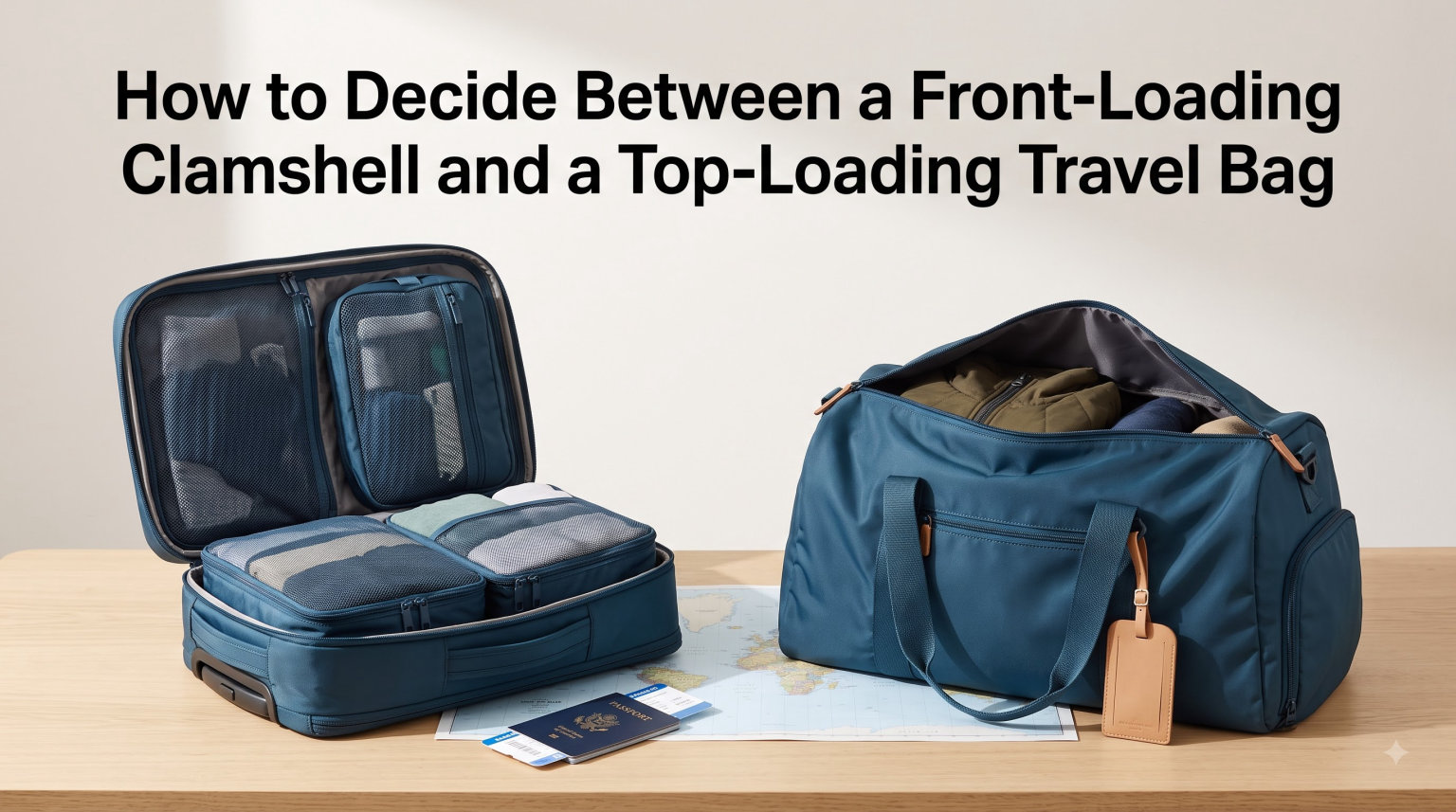
Choosing the right travel bag comes down to one decision that shapes every trip you take: how the bag opens. That single factor — front loading clamshell vs top loading travel bag — determines how you pack, how fast you can grab what you need, and how frustrated you feel in a cramped hotel room or a slow airport security line.
I have traveled with both styles for years across dozens of countries. I have packed clamshell backpacks for week-long business trips in Tokyo and stuffed top-loading bags for multi-day trekking routes in Patagonia. Each design has real strengths that manufacturers love to advertise, and each has genuine weaknesses that product pages never mention.
The frustration of choosing wrong is real. I once spent a two-week Europe trip digging through a top-loading bag every morning, pulling out half my clothes just to find a clean shirt. On another trip, I opened my clamshell pack on a moving train and watched it spill across the aisle because there was no flat surface to lay it on.
This guide breaks down what each opening style actually does in the real world. I will compare them across the factors that matter most — packing speed, organization, airport security, hotel convenience, durability, and security — and then give you a simple decision checklist you can use to pick the right one for your specific travel style. By the time you finish reading, you will know exactly which design fits your trips and which red flags to watch for before you spend your money.
Let us start with the fundamentals.
Table of Contents
What Is a Front-Loading Clamshell Travel Bag?
A front-loading clamshell travel bag opens completely flat, splitting into two halves connected by a zipper that runs around three sides of the pack. Think of it as a soft suitcase with backpack straps. When you unzip the perimeter zipper, the bag hinges open like a clam shell, exposing everything inside at once.
This design goes by several names. You will see it called a clamshell backpack, a panel-loading backpack, or a front loader backpack. They all refer to the same core idea: the main compartment opens wide so you can see and reach every item without digging.
The zipper path is the defining feature. A true clamshell uses a U-shaped or three-sided perimeter zipper that lets the front panel swing open on a fabric hinge. Some bags use a half-zip design that opens most of the way but leaves a fabric spine at the bottom. Full clamshells are more common in travel-focused backpacks, while partial clamshells show up in outdoor and hybrid models.
Inside, most clamshell bags include organizational features that take advantage of the flat layout. You typically find an internal mesh divider on one side, compression straps to hold clothes flat, and sometimes a zippered panel that separates dirty laundry from clean items. The design encourages horizontal layering — you pack in flat stacks rather than dropping items into a deep well.
Clamshell bags dominate the carry-on backpack category. They appeal to travelers who want suitcase-style organization without checking a bag, which is why most one-bag travel packs use this layout.
What Is a Top-Loading Travel Bag?
A top-loading travel bag opens from a single aperture at the top of the pack. You drop items in from above and stack them vertically inside the main compartment. The opening is usually capped by a drawstring collar, a roll-top closure, or a small lid that buckles or zips shut.
This is the classic backpack design. Most hiking packs, climbing bags, and outdoor rucksacks use a top-loading layout because it is structurally simple and does fine in rough conditions. The fewer zippers you have, the fewer failure points exist when you are miles from a replacement.
Top-loading bags come in a few variations. A traditional top loader has a large main opening under a lid flap, sometimes called a brain, that buckles down over the top. A roll-top backpack removes the lid entirely and instead rolls the fabric opening down and clips it shut, which gives you adjustable volume. A drawstring backpack uses a simple cord closure, which is lighter but less secure.
The vertical packing structure is the key difference. Instead of arranging items in horizontal layers like a suitcase, you pack in vertical stacks. The items at the bottom stay at the bottom until you reach them or remove everything above. This works well when you pack strategically — bulky, rarely-used items go at the bottom, and things you need often sit near the top.
Top-loaders tend to be lighter than clamshells because they use less hardware. No full-length perimeter zipper means less weight, fewer potential failure points, and often better weather resistance since the opening can be rolled or cinched tight.
Front-Loading Clamshell vs Top-Loading Travel Bag: Access and Packing Compared
The core difference between these two designs is how you reach your belongings. A clamshell bag gives you full visibility of everything at once, while a top-loading bag requires you to pack strategically because bottom items are hard to reach without unpacking the layers above them.
This single difference cascades into everything else — how fast you pack, how organized you stay, how frustrated you get in a hotel room, and how efficiently you move through airport security.
Packing Speed and Efficiency
Clamshell bags are dramatically faster to pack and unpack. You lay the bag open on a bed or floor, place items in flat layers, and close it up. The process mirrors packing a suitcase, which most people already know how to do intuitively. I can fully pack a 40-liter clamshell bag in about five minutes using packing cubes.
Top-loading bags take more thought. You need to consider the order of items as you pack, because whatever goes in first comes out last. If you pack poorly, you will spend extra time digging for things later. When packed well, though, a top loader compresses gear tightly and efficiently because the cylindrical shape uses space well.
Organization and Visibility
Clamshell bags win on organization by a wide margin. When you open the bag, you see everything laid out flat. Finding a specific sock, grabbing your charger, or checking whether you packed your rain jacket takes seconds. The mesh divider on the interior panel acts like a second layer of organization, holding smaller items where you can see them.
Top-loading bags hide their contents. You see only the top layer when you open the flap. Finding something at the bottom means pulling items out or rummaging blindly. One traveler on the r/onebag forum described it bluntly: every morning they had to dump out half the bag to find clean clothes.
Access During Transit
Here is where the comparison flips. Top-loading bags are better for grabbing items while you are moving. You can reach into the top opening while sitting on a bus or standing in a queue without the bag needing to be fully opened. I frequently grab my tech kit from the top of my pack while waiting in airport lines.
Clamshell bags are worse for in-transit access. Opening the perimeter zipper fully means the bag needs to lay flat or be held in a way that both halves can separate. As one forum user put it, you cannot really open a clamshell without laying it flat, which makes it less convenient for quick grabs during travel.
The table below summarizes how each design performs across the key factors:
| Factor | Clamshell (Front-Loading) | Top-Loading |
|---|---|---|
| Packing Speed | ★★★★★ Fast, flat layers | ★★★☆☆ Requires planning |
| Item Visibility | ★★★★★ Full access to all items | ★★☆☆☆ Top items only |
| Organization | ★★★★★ Mesh dividers, layers | ★★★☆☆ Pack strategically |
| In-Transit Access | ★★☆☆☆ Needs flat surface | ★★★★☆ Quick top access |
| Weight | ★★★☆☆ Heavier (more zipper) | ★★★★★ Lighter |
| Weather Resistance | ★★★☆☆ Zipper vulnerable | ★★★★☆ Roll-top seals well |
| Durability of Closure | ★★★☆☆ Zipper can fail | ★★★★★ Fewer failure points |
Durability, Weather Resistance, and Carry Comfort
Durability and comfort comparisons often surprise people because the answers depend heavily on build quality rather than opening style alone. That said, each design has inherent characteristics that affect how it holds up over time and how it feels on your shoulders.
Closure Durability
The perimeter zipper is both the clamshell’s biggest advantage and its biggest vulnerability. A three-sided zipper that lets the bag open flat is under stress every time you pack tight or overstuff. If that main zipper fails on a trip, your bag is effectively broken. I have seen zipper teeth separate on budget clamshell packs after a year of heavy use, and there is no quick field fix for a blown perimeter zipper.
Top-loading bags have fewer closure points to fail. A drawstring or roll-top closure has no teeth to misalign, no slider to break, and no track to derail. The lid buckle is the only hardware, and buckles are cheap and replaceable. This simplicity is why expedition packs almost always use top-loading designs — reliability matters more than convenience when you are far from civilization.
Weather Resistance
Top-loading bags handle bad weather better. A roll-top closure creates a natural barrier against rain because you fold the opening over on itself, creating layers of fabric that shed water. Many top-loading hiking packs also include a removable rain cover or use waterproof fabric throughout.
Clamshell bags rely on zipper water resistance. Even with water-resistant zipper tape, a driving rain will eventually find its way through the teeth. If your clamshell bag has a rain cover, use it in heavy weather. If it does not, consider a pack liner or dry bags for electronics and documents.
That said, most urban travel does not involve torrential downpours. For city hopping and airport-to-hotel transit, weather resistance differences are minor. The gap matters most for outdoor adventures, trekking, and destinations with monsoon seasons.
Carry Comfort and Load Distribution
Both styles can carry comfortably, but they distribute weight differently. Top-loading bags, with their taller and narrower profile, tend to carry heavy loads closer to your spine. This is why hiking packs use this shape — the load stays centered and stable on uneven terrain. Load lifter straps and a frame sheet help transfer weight to the hip belt efficiently.
Clamshell bags are often wider and flatter, which can pull the load slightly away from your body. For carry-on loads of 20 to 40 liters, this rarely causes discomfort. But if you are carrying 50 liters or more for extended periods, a top-loading design with a proper suspension system will usually feel better on long walks.
Compression straps matter for both styles. They cinch the load tight, prevent shifting, and reduce the profile of the bag for overhead bin storage. Look for side compression straps on any travel bag regardless of opening style.
TSA Security, Airport Lines, and Hotel Room Packing
The way your bag opens affects two of the most stressful parts of travel: getting through airport security and living out of your bag in a small hotel room. These are real-world scenarios that product pages rarely address but that travelers think about constantly.
Airport Security Checkpoints
Clamshell bags have a clear edge at TSA checkpoints. When you need to remove your laptop for scanning, a clamshell bag with a dedicated laptop sleeve lets you unzip a compartment and slide the device out in seconds. Many clamshell travel backpacks have a TSA-friendly laptop compartment that lays flat on the scanner belt, so you do not even need to remove the laptop from the sleeve.
Top-loading bags make laptop removal more awkward. If your laptop sits in a sleeve near the top of the main compartment, you can reach it — but you are pulling it out of a vertical opening, sometimes past other items. If the laptop is buried deeper, you may need to unpack to get it out. Some top-loading bags include a side-access zipper just for the laptop, which helps but adds another potential failure point.
Living Out of Your Bag in a Hotel
Clamshell bags shine in hotel rooms. You open the bag flat on the bed or floor, and it becomes a mini dresser. You can see every item, grab what you need, and close it back up. This works well even in tiny rooms where floor space is limited, because the bag does not need to stand upright to be useful.
Top-loading bags are harder to live out of for extended stays. You either keep the top open and rummage each time, or you partially unpack into a drawer or on a shelf. One traveler on r/ManyBaggers noted that top-loaders encourage you to unpack at each stop rather than living out of the bag, which can be a pro or a con depending on your travel style.
Tight Spaces: Planes, Trains, and Buses
On a plane or train, top-loading bags have the advantage for quick access. You can reach into the top while seated to grab headphones, a snack, or a book without fully opening the bag. With a clamshell, you would need to pull the bag down, find a flat surface, and unzip it halfway — impractical in a window seat with neighbors blocking the aisle.
This is one of the most overlooked factors in the clamshell vs top-loading debate. Forum users consistently mention that clamshell access is great at the hotel but frustrating in transit. The opening method that serves you best depends on where you spend more time needing quick access.
Security Against Theft: Which Design Is Safer?
Neither opening style is inherently theft-proof, but they present different risks. Clamshell bags expose a long zipper that a pickpocket can partially open in a crowded space. The perimeter zipper runs along the side or back of the pack, and a skilled thief can slide a hand in without you noticing in a packed metro car.
Top-loading bags are slightly harder to pickpocket because the opening sits at the top, often under a buckled lid that presses against your back when worn. A thief would need to reach over the top and past the closure, which is more noticeable. Roll-top designs are even more secure because the folded closure takes deliberate effort to open.
Regardless of opening style, look for a hidden pocket on any travel bag. A concealed zippered pocket against your back panel is the safest spot for passports, cash, and cards. Neither a clamshell nor a top-loading design protects you if your valuables sit in an externally accessible pocket.
For destinations with high pickpocketing risk, consider wearing your pack on your front in crowds or using a smaller daypack for valuables. The main bag’s opening style matters less than how you carry it and where you store your most important items.
What Real Travelers Say: Community Insights
I spent time reading through r/onebag, r/ManyBaggers, and r/HerOneBag to find out what actual travelers think about this debate. The community discussions reveal that preferences are strongly tied to travel style, and the same bag can earn passionate praise or sharp criticism depending on who is using it.
One recurring theme is the visibility advantage of clamshells. Multiple users praised clamshell bags for their great visibility and what one person called work-out-of-ability — the ability to treat the bag like a mobile closet rather than a deep well. For travelers who move every few days and never fully unpack, this quality is highly valued.
Top-loading advocates focus on simplicity and weight. As one hiker explained, top-loaders tend to be lighter but need to be packed more strategically to avoid digging for things. Another user preferred a top-loading bag because they found it easier to access their tech kit in awkward places like a train platform or a bus seat.
The most honest assessment came from a traveler who switched from top-loading to clamshell after years of frustration: they had used a big top-loading hiking bag because that was what they saw other backpackers carrying, but they were wrong. Every morning involved dumping out half the bag to find clean clothes. After switching to a clamshell, they never went back.
Community consensus points toward clamshell for urban and business travel, and top-loading for outdoor and adventure travel. But the most experienced travelers often own both — a clamshell for structured trips and a top-loader for trail days.
These real-world perspectives matter more than manufacturer claims. When dozens of travelers independently describe the same advantages and frustrations, you can trust those patterns more than any product listing.
When Each Bag Type Wins: Use Case Breakdown
Different travel situations call for different bag designs. Here is how I would match each opening style to specific traveler profiles based on years of testing and community feedback.
Choose a Clamshell Bag If You Are a…
Business traveler: You need to look organized, access documents and a laptop quickly, and pack efficiently for short structured trips. Clamshell bags let you pack like a suitcase and present professionally at your destination.
Digital nomad: You move between cities every few weeks and live out of your bag. The flat-packing layout and full visibility make daily life easier in Airbnbs and co-living spaces where you may not have drawers or closets.
One-bag carry-on traveler: You refuse to check luggage and need maximum packing efficiency in a carry-on compliant size. Clamshell bags are the dominant design in this category for good reason.
City hopper: You travel between hotels and apartments with frequent packing and unpacking. The suitcase-style opening makes transitions faster and less stressful.
Choose a Top-Loading Bag If You Are a…
Hiker or trekker: You carry gear on trails where durability, weather resistance, and weight matter more than organization. Top-loading hiking packs handle rough conditions better and carry heavy loads more comfortably.
Adventure traveler: Your trips involve mixed terrain, unpredictable weather, and irregularly shaped gear. The flexible opening of a top loader handles odd-shaped items better than structured clamshell compartments.
Minimalist traveler: You travel light with fewer items and prefer the simplicity of a single opening. Top-loaders are lighter, have fewer parts to break, and work well when you are not carrying many items to organize.
Weekend warrior: You need a simple, fast bag for short trips where packing speed and access strategy do not matter as much. A top-loading daypack or small rucksack gets the job done without overcomplicating things.
Hybrid Options and Emerging Designs
If you cannot decide between the two, you are not stuck with an either-or choice. Hybrid bag designs have grown in popularity, blending features from both opening styles to offer more flexibility.
The most common hybrid is the panel-loading backpack with a side or bottom access zipper. This design keeps the top-loading lid for quick access to main compartment items, but adds a U-shaped zipper on the side panel that lets you reach the bottom of the bag without unpacking from the top. It is not a full clamshell — the bag does not open completely flat — but it solves the biggest complaint about top-loaders: bottom-item access.
Another approach is the clamshell bag with a quick-access top pocket. Some travel backpacks use a full clamshell main compartment but add a smaller top-loading compartment for items you need frequently, like a jacket, snacks, or headphones. This gives you suitcase-style packing for the main load plus grab-and-go access for transit essentials.
Hybrid designs tend to cost more and weigh slightly more because they include extra zippers and compartments. But for travelers who split time between urban and outdoor environments, the versatility can be worth it. The trade-off is that hybrids do not fully excel at either style — they are a compromise, not a replacement for a dedicated clamshell or top-loader.
When evaluating a hybrid, check whether the secondary access point actually reaches deep into the bag. Some side zippers only access a shallow pocket rather than the full main compartment, which defeats the purpose. Read reviews and look at interior photos before buying.
Common Mistakes to Avoid When Choosing
After years of testing travel bags and reading hundreds of forum posts about packing frustrations, I see the same mistakes repeated. Avoiding these will save you money and headaches.
Mistake 1: Choosing based on looks alone. A sleek clamshell backpack might look great in product photos, but if your travel involves frequent outdoor transitions where you need quick top access, you will be frustrated. Match the design to your actual travel patterns, not the aesthetic.
Mistake 2: Ignoring zipper quality on clamshells. The perimeter zipper is the single most important component of a clamshell bag. A cheap zipper will separate, jam, or fail entirely. Look for YKK zippers, lockable sliders, and dual-zipper designs that let you secure the bag with a small padlock.
Mistake 3: Overpacking a top-loader without a strategy. Top-loading bags work beautifully when packed thoughtfully. They become a nightmare when you stuff items randomly. If you choose a top-loader, invest in packing cubes and commit to packing in deliberate layers: rarely used items at the bottom, daily items at the top.
Mistake 4: Assuming bigger means better for carry-on. Both clamshell and top-loading bags come in carry-on sizes, but clamshell bags are more likely to hold their shape and fit overhead bin sizers. Top-loading bags can bulge and become non-compliant when overpacked. Check the packed dimensions against your airline’s limits.
Mistake 5: Forgetting about underpacked sag. Clamshell bags can lose their shape and look floppy when underpacked, especially if there is no internal frame sheet or stiffener. If you travel with varying loads, look for a bag with structure that holds up whether it is half full or completely stuffed.
Quick Decision Checklist for Choosing Your Travel Bag
Use this step-by-step checklist to work through the front loading clamshell vs top loading travel bag decision for your situation. Answer each question honestly based on how you actually travel, not how you wish you traveled.
Step 1: Where do you spend most of your travel time?
If the answer is cities, hotels, and Airbnbs, lean clamshell. If the answer is trails, campsites, and outdoor adventures, lean top-loading. This single question resolves the debate for about 80 percent of travelers.
Step 2: How often do you need to access items from your bag during transit?
If you frequently grab things while on buses, trains, or planes, a top-loading bag gives you faster in-transit access. If you only need your bag’s contents when you arrive at your destination, a clamshell is fine and offers better organization.
Step 3: Do you pack with packing cubes or prefer loose packing?
Packing cubes work beautifully with clamshell bags because the flat layout lets you stack cubes like drawers. If you use cubes religiously, go clamshell. If you pack loose and do not mind a more freestyle approach, either works.
Step 4: What climate and weather conditions do you typically encounter?
Heavy rain, snow, or dust favor top-loading designs with roll-top closures that seal tightly. Urban travel in moderate climates does not require the weather resistance advantage, so either style works.
Step 5: How heavy is your typical load?
Loads over 35 pounds and 50 liters favor top-loading designs with proper suspension systems. Lighter carry-on loads of 20 to 40 liters are comfortable in either style. If you carry heavy loads regularly, prioritize the harness and hip belt over the opening mechanism.
Step 6: How important is laptop access for your trips?
If you travel with a laptop and go through airport security regularly, clamshell bags with dedicated laptop compartments make security lines far less stressful. If you rarely fly or do not carry a laptop, this factor drops off your priority list.
Step 7: What is your budget for replacing a failed component?
Clamshell bags have more hardware to fail, and a broken perimeter zipper can render the bag unusable mid-trip. Top-loading bags have simpler closures that are easier to field-repair. If you travel in remote areas far from replacement options, simplicity wins.
If you answered mostly clamshell on Steps 1 through 4, go with a front-loading clamshell bag. If you answered mostly top-loading on Steps 1, 4, 5, and 7, a top-loader fits your needs better. If you are split down the middle, seriously consider a hybrid design.
FAQs
Why do people like clamshell backpacks?
People like clamshell backpacks because they open flat like a suitcase, giving full visibility of every item inside. This makes packing, unpacking, and finding specific items much faster than with a top-loading bag. Clamshell bags also work well with packing cubes and are ideal for business travel, digital nomad lifestyles, and carry-on-only trips where organization matters.
What is the difference between top loading and clamshell luggage?
A clamshell bag opens completely flat using a perimeter zipper that runs around three sides, splitting the bag into two halves like a suitcase. A top-loading bag opens only from the top through a drawstring, roll-top, or lid closure, requiring items to be packed and accessed vertically from above. Clamshells offer better organization and visibility, while top-loaders are lighter, simpler, and more weather-resistant.
Are clamshell backpacks good for travel?
Yes, clamshell backpacks are excellent for most types of travel, especially urban trips, business travel, and carry-on-only journeys. They pack like a suitcase, keep items organized with flat layers and mesh dividers, and make airport security easier with dedicated laptop compartments. They are less ideal for hiking and outdoor adventures where weather resistance and load-carrying comfort matter more.
What is the best type of bag to travel with?
The best travel bag depends on your trip type. For city travel, business trips, and flights where you want carry-on convenience, a clamshell backpack is usually the best choice. For hiking, trekking, and outdoor adventures, a top-loading pack handles weather and heavy loads better. Many experienced travelers own both types and switch based on the trip.
What layout is more durable in the long run?
Top-loading bags tend to be more durable in the long run because they have fewer closure components that can fail. A drawstring or roll-top closure has no zipper teeth to separate and no slider to break. Clamshell bags rely on a perimeter zipper that is under constant stress, and if that zipper fails, the bag becomes difficult to use. However, well-made clamshells with quality YKK zippers can last for years of regular use.
Final Verdict
The front loading clamshell vs top loading travel bag debate does not have a universal winner — it has a correct answer for each traveler based on how they actually move through the world.
Clamshell bags win for organization, visibility, packing speed, and airport convenience. They are the right choice for business travelers, digital nomads, city hoppers, and anyone who lives out of their bag in hotels and apartments. The suitcase-style opening transforms packing from a chore into a quick, satisfying process.
Top-loading bags win for simplicity, weather resistance, carry comfort with heavy loads, and quick in-transit access. They are the right choice for hikers, adventure travelers, and minimalists who value fewer failure points and lighter weight over flat-packing organization.
Hybrid designs bridge the gap for travelers who do both — city trips one month and trail days the next. They cost more and weigh slightly more, but they offer flexibility that dedicated designs cannot match.
My recommendation is simple: be honest about your travel patterns. Most people overestimate how much they need outdoor durability and underestimate how much they value daily organization. If you are unsure, start with a clamshell design, because the packing efficiency and visibility advantages benefit nearly every type of trip. You can always add a top-loading daypack for trail use later.
Whatever you choose, focus on build quality. A well-made bag of either style will serve you better than a poorly made bag of the theoretically correct style. Look for quality zippers, comfortable harness systems, and a design that matches the trips you actually take — not the trips you imagine taking.